Earlier this week, I walked outside in shorts and a t-shirt for the first time in a long time. Ginger was with me, which has not been a given since January. The temperature was what my kids used to call Goldilocks weather. Not too hot. Not too cold. Just right. It felt like spring, which is one of my favorite seasons, and for a few minutes it felt like something else too. It felt like before.
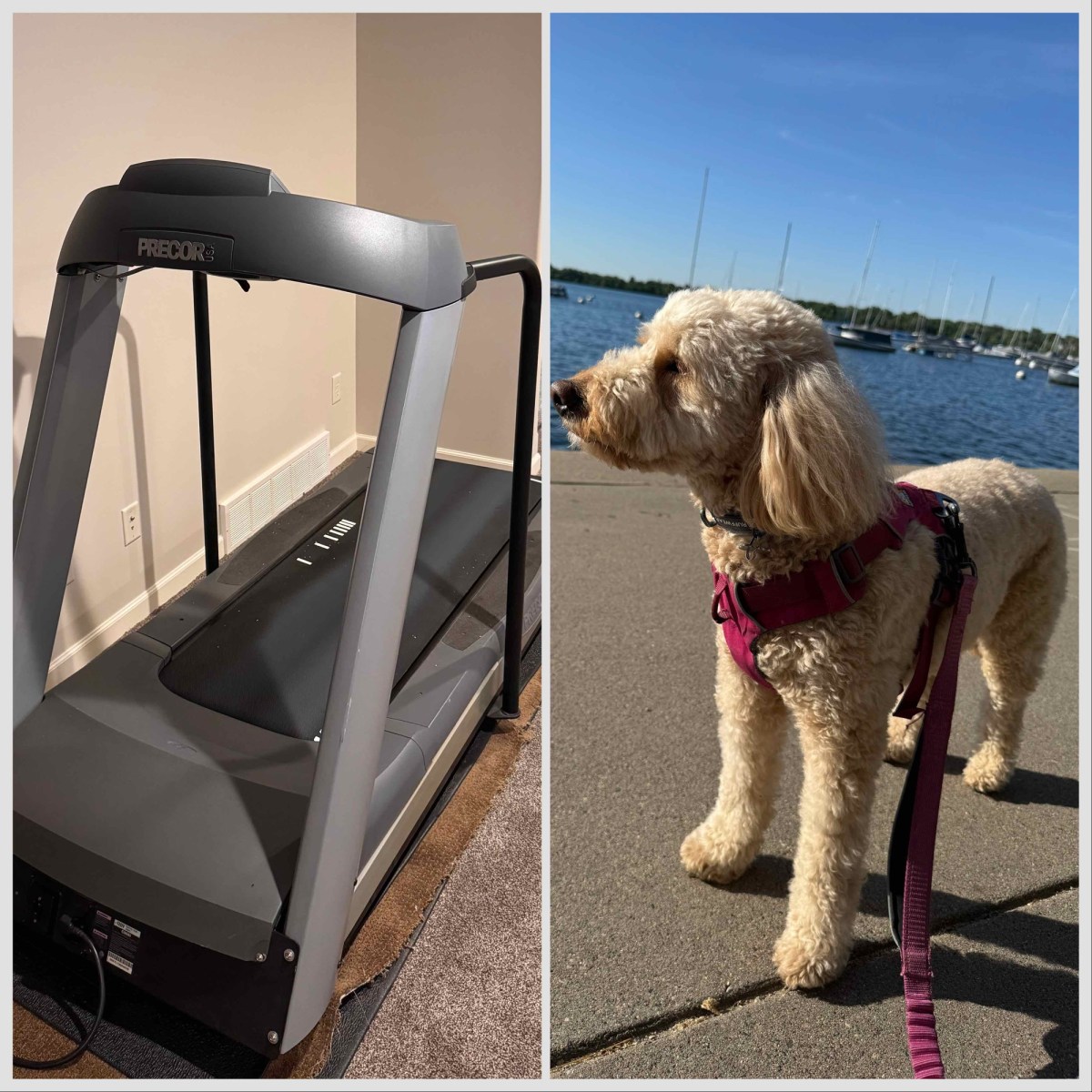
After my fall, the winter was a lot of treadmill miles. Necessary, functional, and about as inspiring as a dentist waiting room. The streak stayed alive, but the treadmill is not this. It is not the morning air or the way Ginger’s ears go up when she realizes we are actually going outside and not just standing near the door. It is not pavement under your feet or the specific quality of light that only exists in early morning in May. The treadmill is the backup system. This is the real thing. I have been thinking about backup systems a lot lately.
The streak is important to me. It is not worth my life. Those two things can both be true, and learning to hold them together has been its own kind of discipline. Ginger has paid the price for my caution more than anyone, which is not entirely fair to her. But here we were on Tuesday morning. Back outside. Goldilocks weather. Shorts and a t-shirt. The dog happy in the way only dogs can be happy, completely and without reservation.
On one of those treadmill mornings earlier this week, before the shorts and the t-shirt and the Goldilocks weather, I was reading about Canvas on my iPad while walking in place in my basement. Canvas had been hit with a ransomware attack. The system was down. Data had been breached. Somewhere, someone was waiting to get paid.
For those who do not spend their lives around universities, Canvas is the learning management system that runs coursework, gradebooks, assignments, and submission records at a majority of American colleges and universities. Michigan uses it. Minnesota uses it. So do Harvard, Stanford, MIT, and Cal Berkeley. The public school district down the street uses it. Everyone uses it. Well, almost everyone. Purdue made a different call. North Carolina State uses Moodle, which used to be the system at my former institution before Canvas became the answer to a question nobody asked out loud.
The ransomware attack was timed with surgical precision. End of semester. Grades due. Students at maximum anxiety. Every hallway conversation and email orbiting the same question. Then suddenly, the whole system was gone. I later learned that the day before the attack, my former institution had recommended a policy requiring faculty to use Canvas or suffer consequences that were not fully specified but were clearly intended to sound unpleasant. One day later, Canvas did not exist. The universe, apparently, was paying attention.
In the days after the attack, I came across social media posts and articles from professors, mostly in the humanities. Most were people I have never met. A few were former colleagues. Many smugly announced that this never happened before Canvas, that the old system worked fine, and that if we simply returned to bluebooks and spiral notebooks we would all be safe from hackers. They were not wrong that ransomware cannot attack a filing cabinet. They were wrong about almost everything else. A bluebook and a spiral notebook are one fire, flood, theft, or dog with poor judgment away from a semester that never existed. The filing cabinet has no redundancy, no recovery, and no mercy. That is not a backup system. That is cognitive dissonance with a manila folder.
My response to all of this has mostly been a Gen X eye roll. We are the generation that typed college papers on typewriters with margin formatters because the alternative was starting over. We are the generation that had that one professor, and you know exactly who I mean, who required footnotes at the bottom of every page instead of endnotes because he had decided that was how civilization worked and your convenience was not his problem. In law school, we saved papers every ten minutes and printed them every half hour. By the end of a writing session there would be a stack of drafts on the desk and no reliable way to know which one was current. That was our backup system. We learned early that the tools were never as reliable as they looked and the system was never your friend. So when administrators started calling Canvas innovation, some of us smiled, nodded, and kept backing things up.
And because Gen X does not brag about this kind of thing, I will simply say that my gradebook most likely would not have been impacted. During my last semester teaching, I was required to use Canvas as my LMS. Every time I entered a grade into Canvas, I exported the file into an Excel spreadsheet saved in two places: my computer and a thumb drive. My syllabus was not contained in Canvas. It was uploaded to Canvas, which is a different thing entirely. Assignments were separate files. Canvas was the display window, not the warehouse. I did this because systems fail. Not sometimes. Eventually. All of them.
I have been walking every day for nearly seven years. Two thousand two hundred and some days, depending on when you are reading this. The streak began on March 1, 2020, and I know that the way I know my own birthday. Every step since then has been counted by a device, transferred to software, uploaded to an app that tells me immediately where I stand and how long the streak has been intact. The streak is simple in its requirements and unforgiving in its execution: a minimum of ten thousand steps, every single day, without exception. Early on, that number mattered more than it does now. I needed to see it. Now I just need to know it.
If the watch dies tomorrow, if the software crashes, if every piece of technology I use to track this disappears overnight, and I have already walked at least ten thousand steps that day, the streak is still intact. The walk happened. The streak exists in the record, yes, but it also exists somewhere the record cannot touch. I know for a fact that I have walked every day since March 1, 2020. No ransomware attack changes that.
The grades and assignments should work the same way. The learning happened. The work happened. The record of it should be protected, backed up, saved in more than one place. But the work itself belongs to something no system can hold and no hacker can touch. Canvas was the display window, not the thing itself.
The treadmill kept the streak alive all winter. It is not the walk. It was never the walk. But it was there when the walk was not possible, which is the only thing a backup system needs to be.
I will walk this morning. I will write down the number. Somewhere, somebody will back up a gradebook before the semester closes. Somebody else will not.

 Sireadh Toileachas