What a Mother Is

A Mother’s Day essay about the several mothers in one life — the mother who raised me, the birth mother I found after fifty years, and the woman I chose. Each gave me something the others couldn’t.

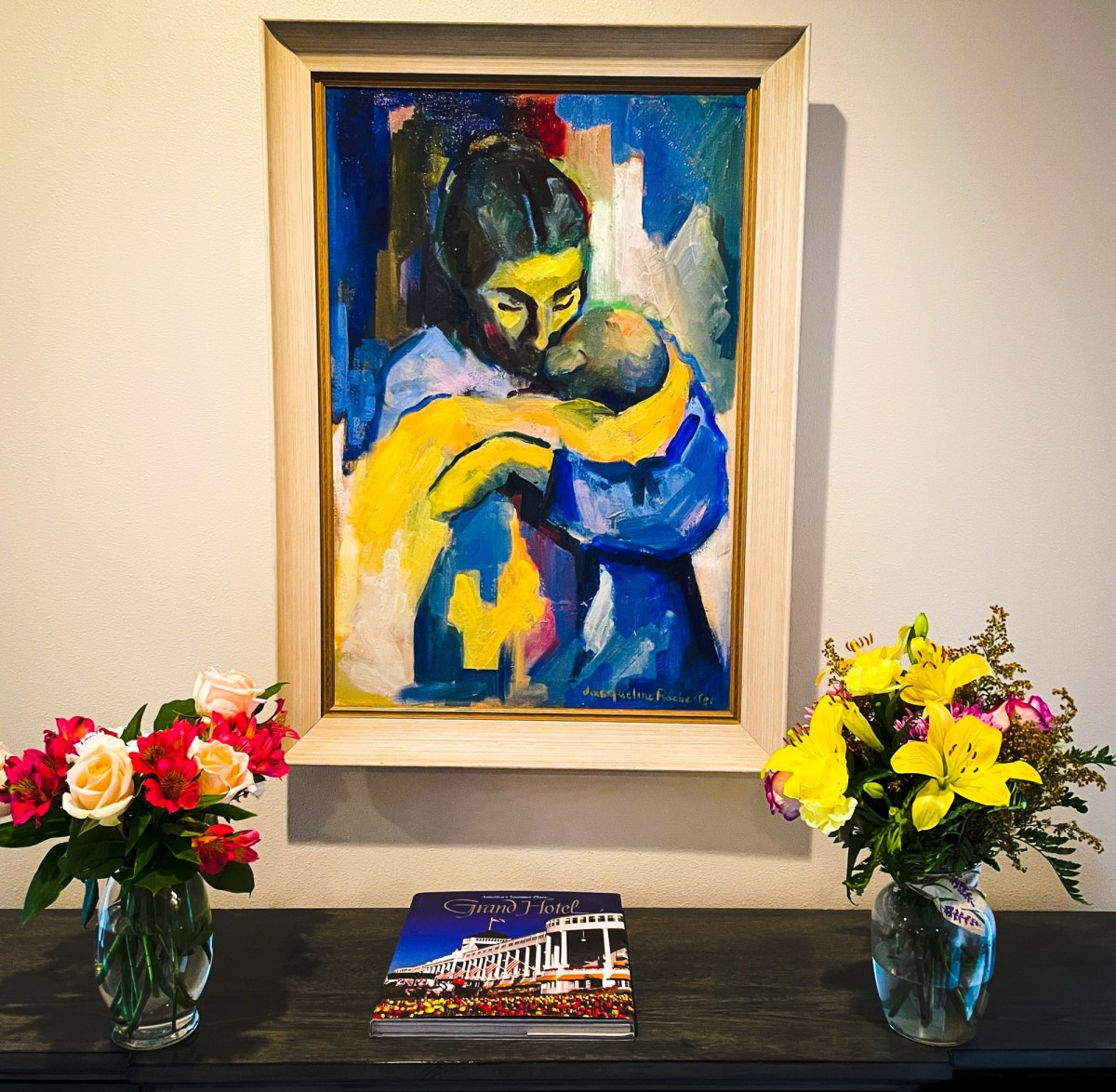
There is a painting in my home that has always been part of my life. A mother holding a child, rendered in bold blues and yellows by a local artist named Jacqueline Rochester. My parents bought it from her when she was a neighbor. Years later, I inherited it. My wife lets me keep it in our home. I am not someone who is moved by a great deal of art. I am moved by this one.

It hangs in the main room. At some point, Mother’s Day flowers ended up on either side of it without anyone planning it. Two bouquets framing a mother and child. It seemed right to leave them there. Tomorrow is Mother’s Day. Early in life, the assumption built into all of it, the cards, the brunches, the flower displays waiting near every grocery store entrance, is that you only have one mother to think about. That is true for a while. Then life keeps moving and the math changes.

There are several mothers in my life, each of whom gave me something the others could not. Every second Sunday in May, I think about all of them.


My mother was everything a young child could want. Caring, compassionate, creative, kind. She made my lunch every day, always my favorite foods. When dinner came, she cooked multiple meals to keep all of us happy. My father, who grew up in a time when food was not always plentiful, would have told us to eat what was in front of us and be grateful. My mother just cooked another meal.

It was early June when a flash flood devastated my hometown. Two hundred and thirty-eight people died in a matter of hours. I was four years old, so my memories are not complete. I remember pieces. Bridges washed out. Cars upside down in department stores. Water and sewer service gone. Close family friends lost their home and lived with us for six or eight weeks. We shared what we had. When we needed drinking water, we drove to an elementary school where tanker trucks had been set up for families. Standing in line filling jugs should have felt strange or frightening. My mother made it feel like an adventure. She made turning on a faucet sound dull by comparison. What four-year-old gets to drive to a school to pick up water?

Looking back now, I realize the same qualities that made her a good mother also made her good on television. “A Woman’s Touch With Mary Ann” was a local talk show, and she was its host. Before tapings, I watched her settle nervous guests with conversation. She made them comfortable. She treated them like they were the most important person in the world, and for those few minutes, maybe they were. She interviewed Phil Donahue, Bob Hope, and, before much of the country understood what it was seeing, Oprah Winfrey. I have sometimes wondered what would have happened if she had been born in a different era or found her way to a bigger market earlier. She never wondered out loud. She may have known it. She never let on.

When South Dakota decided to close the institution where both of my brothers lived, one for twenty-five years and the other for nearly fifteen, my mother went to work. She wrote letters, made calls, cornered politicians, and fought for her sons the way only a mother can fight when she has nothing to lose and everything to protect. In the end, the institution closed anyway. She did not win. But by the end of it, the governor knew exactly who she was. For a mother fighting for her kids, that is not nothing.

In late April and early May, the pasque flower bloomed across our property in the Black Hills. Purple and low to the ground, the first sign winter had finally loosened its grip. Every spring I picked bouquets for my mother without being asked. What I did not know at the time, or perhaps did not care about, was that the pasque flower is the South Dakota state flower, and picking it is technically illegal. I was out there committing crimes for my mother on a seasonal basis. She never once mentioned it. She took those bouquets like they were the greatest gift she had ever received, and she made me feel like maybe they were. Even in college, if I happened to be home at the right time, I still picked them. Some habits survive childhood intact.

She wasn’t there the day I was born, but she is the beginning of every memory I have. She is my original Mother’s Day. She’s gone now. But every May she returns a little.


Maybe that is part of getting older. You realize the people you have lost are not gone in any practical sense. They remain in habits, stories, meals, flowers, holidays, and even the objects sitting quietly in your home. Mother’s Day stopped being simple for me a long time ago because eventually I realized there was another mother thinking about me too.

In the summer of 1968, a twenty-year-old junior at Florida State University arrived in Sioux Falls alone, unmarried, and pregnant. In that era, those facts carried their own social sentence. She lived in a basement apartment for four months. She sewed clothes. She read books. She watched baseball. When the time came, nurses took the baby before she could hold him. She knew only that he was a boy. Then she went home and rebuilt her life. She married, had children, built a career, and kept the secret for fifty years. The hardest days, she later told me, were Christmas, Mother’s Day, and June 15th, the birthday she knew was being celebrated somewhere by someone.

That boy was me.

I found Sandi the way people find things now. A DNA test led to a first cousin match, some internet sleuthing, and eventually, to her. The letter I wrote her took nearly two weeks. I gave her every possible exit because I did not know what waited on the other side. On Christmas Eve 2018, I was standing in a Hy-Vee checkout line, already irritated about something I can no longer remember, when I checked my phone and saw an email subject line that read “Happy Christmas.” I left the cart where it was and walked to my car. I sat there reading the words of a woman I had never met, a woman who had thought about me every Christmas for half a century. At some point I started crying. By the time I drove home, whatever had irritated me ten minutes earlier had completely disappeared.

We met in North Carolina the following spring. She saw me come through the airport terminal and recognized me instantly. To anyone watching, the resemblance probably made the whole thing obvious. She held me the way she had not been allowed to hold me fifty years earlier. For most of my life, adoption had felt abstract to me, almost administrative. A fact more than a feeling. Meeting Sandi rearranged that.

Sandi gave me two things no one else could give. She gave me life. And she gave me up so I could have a better one. I did not understand the size of that decision until I became a parent myself. Both required courage. Both were acts of love. It took me five decades to understand that, but I understand it now.

The painting changed a little after that. For years I had mostly seen comfort in it. After finding Sandi, I started noticing the grip in the mother’s arms.


I did not get to choose the first two women in this story. They came to me the way most things in life do, through circumstance, timing, and decisions made by others. Wanda I chose. She chose me back. What followed has been the great gift of my life, and I have never once found the words adequate to describe her.

Wanda is not a June Cleaver mother. She didn’t bring treats to the ball games. But she made sure her boys got there, on time, with every piece of equipment they needed, which anyone who has ever tried to get a child out the door for a game knows is no small thing. She grew up with only a sister. Boys were not part of her original instruction manual. She figured it out anyway. I’d like to think I helped with the translation.

What she did was harder and quieter than the performing version of motherhood, and she never pretended otherwise. She led by example. She became a role model for her boys without any of them noticing it was happening, which is the only way that actually works.

She protected them, even from me. There were moments when I had something to say and she would suggest another approach. She was right. Every time. Her version of mothering was never hovering. She let her boys figure things out on their own, which takes more restraint than most people realize. When they needed to be challenged, she challenged them. When they needed to be held accountable, she held them accountable. She had a gift I never fully mastered. She could chew them out and motivate them in the same breath. I could only manage the first part.

There is one moment, though, that I come back to more than any other. Our oldest was seven years old when he hit a tree on a ski slope and cracked his skull. We had just found out we were pregnant with our youngest. The doctors were careful with their words. The next 48 hours would be key. That was all they could tell us.

The first night, the two of us folded ourselves into a single recliner in that hospital room, holding each other, not saying much. There wasn’t much to say. Outside the window, the world was going about its business. Inside that room, everything had narrowed down to the sound of a monitor and a seven-year-old’s breathing.

She stayed. The second night, she insisted I go to the hotel. One of us needed real rest, she said. One of us needed to be ready for whatever came next. She had already decided it wasn’t going to be her turn to step back. She sat awake through the night carrying one child while watching over another, and she did it without drama, without complaint, without asking anyone to notice.

We knew he was going to be fine when he started trying to make shapes on one of the monitors, controlling his breath, watching the screen, turning medical equipment into a game. That’s a seven-year-old telling you he’s back. We laughed. On the third day, we went home.

Wanda has been that woman every day for more than twenty-five years. I have a law degree and I teach for a living. I am reasonably good with words. They are not sufficient when it comes to her.


There are several mothers in my life. I am not confused by that. I am grateful for it. Each one of them gave me something the others couldn’t.


Tomorrow is Mother’s Day. There will be flowers and a card, and if I know Wanda, she will insist neither was necessary. Ginger will spend the day underfoot, hoping the occasion calls for a longer walk than usual. Somewhere in North Carolina, Sandi will think about June 15th, except now she knows where the story ended. And I will think about my mother, who spent much of her life making difficult things feel manageable for the people around her.

The painting will still be there when we get back. A mother holding a child between two bouquets no one planned.

See You When Silver Turns to Gold

Twenty-five years ago today it was raining in Rapid City. The places are mostly gone. The day is completely intact.

They say it’s good luck if it rains on your wedding day. Twenty-five years ago today, it was raining. I remember because my soon-to-be wife was worried about her hair. That has held up as a theme. I do not worry about my hair, one of the advantages of not having much left to negotiate. It was also Cinco de Mayo, and I’ve always suspected that wasn’t entirely accidental.

We were married at the Chapel in the Hills, a replica stave church in Rapid City honoring her Norwegian Lutheran heritage and a shared Augustana history, even if we hadn’t found each other there yet. Only our families were invited. Our friends found out later, which was less dramatic than it sounds and exactly how we wanted it. Nine people. Small, quiet, and right.

After the ceremony, we had lunch at the Canyon Lake Chophouse. It’s gone now. That evening, after everyone went their separate ways, we drove to Deadwood for dinner at Jake’s, on the top floor of the Midnight Star. It felt like the right place for that night. It closed about ten years ago, reopened at some point, and I’m not entirely sure what it is now. After dinner, we headed to our family cabin at Terry Peak. We sold that about fifteen years ago.

The Chapel in the Hills is still there, but much of the rest has shifted. The restaurant where we celebrated with family is gone. The place where we had our first dinner as a married couple has been through at least one more life. The cabin where we ended the night is no longer ours. Many of the places that framed one of the most important days of our life no longer exist, or no longer belong to us, or have become something else entirely. And yet the day is completely intact.

We are not the same as we were that day either. A lot of life has happened. We expanded our family. We built a home. We buried a parent. We buried a brother. We built careers and then rebuilt them. We watched both kids grow up and leave, which is the point and also a terrible system. It wasn’t all sunshine and puppy dogs, though we did eventually get the dog. There were ups, a lot of them, and some downs. We rode them out. Everything around us shifted. We shifted too. But through all of it, one thing never moved. Us.

Twenty-five years is long enough to know which fights weren’t worth having and short enough to remember having them anyway. Long enough to finish each other’s sentences and still occasionally be surprised by the person sitting across the table. Long enough to understand that showing up, day after day, in the ordinary and the hard and the unremarkable, is the whole thing.

So, to the woman who worried about her hair in the rain on a cool May morning in Rapid City, thank you. For your love, your patience, your understanding, your compassion, our children, and the thousand quiet Tuesdays that nobody writes about but that are the whole story.

Your hair looked great, by the way. It always does.

See you when silver turns to gold.

How Then Shall We Live

A professor, lawyer, lifelong learner, reflects on what college actually gave him – a World War II barracks, a prehistoric novel, Arthur Miller, and a holocaust survivor who answered the question that still matters most.

The graduation announcements have started arriving in the mail. Envelopes from family members, children of friends, and young people I know mostly through Christmas cards, sidelines, and the long social web of a South Dakota life, where there are at most two degrees of separation between anyone in the entire state, and that may be generous. They are heading toward ceremonies and photographs and whatever comes next. I am not standing at the front of a classroom anymore. But every spring, when the announcements arrive, I find myself thinking about what college meant, what I missed while I was in it, and whether it still offers young people something worth the cost, the time, and the trouble.

I have been thinking about this one for a while, trying to figure out how to say what I want to say. The topic is too big. The question is too complicated. Every time I think I know where it is going, it turns out I don’t, which is either a sign that I am not ready to write it or a sign that it is exactly the kind of thing worth writing. I have decided to believe the latter and proceed accordingly.

Consider this a first pass. I will come back to it. The question demands that. And it may demand more than one answer.


There was a quote on the wall of a classroom at Augustana College that I have never forgotten. It belongs to the philosopher George Santayana: “Those who cannot remember the past are condemned to repeat it.” The building that held it had its own history. After World War II, Augustana purchased several barracks from the Sioux Falls Air Base and moved them to campus to accommodate a surge in enrollment. One of them, an H-shaped structure, became the Science Building, and later the Social Science Building, with a little theater tucked inside. It lasted nearly sixty years before finally coming down. For those who took classes there, it is hard to forget and hard to describe. Santayana’s quote went with it. Some things have to be carried.

Augustana College, Augustana University now, in the late 1980s was a small Lutheran liberal arts institution on the plains of South Dakota, the kind of place that took seriously the question of what education was for. Not just what you would do with it, but what it would do with you. You would study across disciplines. You would sit with ideas that made you uncomfortable. And at the end, if the institution had done its job, you would be prepared to wrestle with the question that sat underneath all of it: how then shall we live. And, though no one said it quite this way, how then shall we not.

The question, of course, is whether a place like that still exists, or whether we have priced it out, streamlined it away, or explained it so poorly that people no longer recognize its value when they see it.

I did not appreciate any of this at the time. I was eighteen. I had opinions and a meal plan and very little else. The liberal arts made no particular sense to me. College itself made no particular sense to me.

My father had two requirements for everyone in our family. The first was piano lessons. I took them long enough to negotiate my way out, eventually arguing that being in band should count for something. He accepted this, either because he agreed or because he was tired of the negotiation. The second requirement was not negotiable: you are going to college. My parents believed, with the certainty of people who had thought this through, that a degree was the most reliable path to a life with options. They had also, I suspect, done an honest assessment of my manual skills and concluded that the alternatives were limited.

So I went. I had no idea that over the next four years the place would fundamentally change me. I had no idea that a barracks turned classroom, a book I did not want to read, a playwright I did not seek out, and a quote on a wall I walked past a hundred times would still be with me decades later. The place changed me mostly for the better. I say mostly because I am a GenX kid with a healthy suspicion of clean endings. It was college. Some of it was a mess. But the mess turned out to matter too. It would be years before the liberal arts really set in — not until I found myself on the other side of the classroom, looking out at eighteen-year-olds with opinions and meal plans and very little else, and finally understood what had been happening to me all along.


At some point I enrolled in a course called God in the 21st Century: In Search of Fresh Images and New Metaphors. The title was the course. This was not about doctrine or tradition. It was about what happens when the old frameworks stop holding, when the answers no longer fit the questions people are actually asking.

I was assigned Jean Auel’s The Clan of the Cave Bear. My initial reaction was not enthusiastic. A five-hundred-page prehistoric novel in a religion course felt like a category error. We were given two days to read it, which felt less like pedagogy and more like a test of endurance. What stayed with me was not the plot but the structure underneath it, the way authority operated, the way people signaled power and enforced it. I did not have language for that at the time. I do now.

We also read Shusaku Endo’s Silence and The Last Temptation of Christ by Nikos Kazantzakis. I remember liking Silence without being able to tell you why. Some books work on you quietly and leave no forwarding address.

Kazantzakis stayed with me more clearly, mostly because of what was happening around it. The film adaptation had just been released and people were furious. Protests, boycotts, the full apparatus of public outrage. As a junior I did not fully understand the reaction. I understand it better now. He was not writing the untouchable figure many churchgoers recognize. He was writing the human one, a man who wrestled with the possibility of walking away. What if he had refused the role. What if he had chosen an ordinary life. The church has always held that Jesus was both fully human and fully divine. Kazantzakis chose to dwell inside that human struggle, and that alone was enough to bring people into the streets. Today I can see why deeply religious people would struggle with that. But I think that tension — human and divine, doubt and commitment, the road taken and the one refused — is actually at the heart of who Jesus is. The controversy, it turned out, was the lesson.

The professor knew something I didn’t. That is usually how it works.

It was an English course that introduced me to Arthur Miller’s Death of a Salesman. It was on the syllabus, and attending his campus lecture was part of the assignment. I did not seek out the experience. It was required. And yet I sat there and thought: I am in the presence of history. The man had been married to Marilyn Monroe. He talked a little about his writing and I don’t remember much of what he said. What I remember is knowing I was somewhere important, even if I couldn’t have explained exactly why. I was twenty years old and that was enough.

What stayed with me was not the lecture. It was the play. Willy Loman did not fail because he worked too little. He failed because he believed the wrong things about what success meant. He believed the hustle was the point. He was wrong then. We are still getting this wrong. Every new wave of technology resets the hustle without changing the error underneath it. The tools change. The mistake doesn’t.

Which makes the question unavoidable: if college is still worth it, it has to do more than credential the hustle. It has to correct it.


Here is something they do not put in the brochure: higher education is terrible at explaining itself. Colleges will tell you the liberal arts are important. They will hand you a course catalog and a tuition bill and a vague promise about critical thinking. What they will not do often enough is tell you what it is for. Longevity is not an argument. And when they fail to explain it, people quite reasonably start to wonder whether it is worth what it costs.

I spent much of my adult life on the other side of the classroom. Somewhere in the neighborhood of 1,200 students sat in front of me, most of them business majors, most of them practical, most of them focused on what the degree would get them. I do not say that as criticism. It is honest. I understood it because I had been exactly the same way, sitting in a barracks turned classroom, annoyed about a book on prehistoric humans, completely unaware that I was being handed something I would spend the rest of my life unpacking.

But here is what I watched happen, year after year, with the consistency of a well-run experiment: the students who could think across disciplines were better at everything else. Not a little better. Meaningfully better. The accounting major who had wrestled with philosophy could construct an ethical argument under pressure and make it hold. The finance student who had read history understood something his peers sometimes missed — that markets are not machines, they are human systems, and human systems are not rational, they are emotional, and emotional systems repeat themselves with remarkable loyalty to their worst instincts. The business student who had learned to write, really write, could walk into a room and move people with a memo. These were not soft skills decorating the edges of a real education. They were the real education, wearing a different name tag at the conference.

If you are asking whether college has value, this is where I would point. Not to the credential, not to the starting salary, but to the ability to think, to connect, to see patterns where others see noise. Those things compound. They are hard to measure in the short term and almost impossible to replace later.

The argument that liberal arts and vocational programs are rivals is one of the more persistent and counterproductive ideas in American higher education. It is also wrong. The business major and the philosophy major need each other. The nursing student and the history student are asking different versions of the same question. The vocational and the liberal are not competing tracks. They are the same education, approached from different doors, and the ones who figured that out — who let the two inform each other — were the ones who could do things the others couldn’t quite explain.

At Augustana there was a senior capstone course built around exactly this idea. Three disciplines. Humanities, social sciences, natural sciences. The assignment was to put them in conversation with each other, to find the connective tissue, to arrive at something that none of them could produce alone. It was the institution making its argument at last, showing its hand after four years of dealing cards. The course was asking students to do what the whole education had been preparing them to do. It was asking them to think. Not about one thing. About everything, together, at once. And underneath all of it, the question the curriculum was always really about: how then shall we live.

That capstone course was part of a new curriculum Augustana implemented in the late 1980s, an institutional bet that the whole education should build toward something. It was the right bet. In my final years on the faculty, much of it driven by a dean who I believe fundamentally misread what the curriculum was for, the capstone was dismantled and replaced with a first-year experience. The question moved from the end of the journey to the beginning. I thought it was a mistake then. I still think it was a mistake. You cannot answer how then shall we live before you have lived anything. The capstone worked because students arrived at it carrying four years of accumulated confusion, challenge, and occasional revelation. That accumulation was the point. Strip it away and you have a nice orientation exercise. You do not have an education.

This is, I think, what is missing from higher education today. Not funding. Not technology. Not innovation. The willingness to ask the hard question at the moment when it might actually land.

The course was a January term. One month. Three professors. Every day. Peter Schotten, Murray Harr, and Sandra Looney. I want to name them because they deserve to be named.

Peter was Jewish, one of the smartest men I have ever known. As a professor he challenged you and pushed you, and he did it with the confidence of someone who knew exactly what he was building. He was my pre-law advisor and mentor, and when I later returned to Augustana as a colleague he continued to be both. I spent my entire teaching career trying to emulate him. I never did.

Murray had been raised Jewish, had family members who survived the Holocaust, had found his way to Lutheranism, and would later find his way back to Judaism. He had lived the questions he was asking. That mattered. It showed up in the way he taught, in the way he moved between traditions, in the way he assigned books that did not make sense until years later. It was Murray who, earlier, had assigned Clan of the Cave Bear. I understood it better now than I had then.

Sandra Looney was extraordinary. I have tried to find the adequate words for what she brought to that room and I cannot. Some things resist description. What I can say is that all three of them knew exactly what they were doing, and that the month they built together was the most intellectually alive I have ever felt in a classroom.

The centerpiece of the course was a trip to Minneapolis. We stayed at a Lutheran seminary, which felt appropriately on brand for a small Lutheran college on the plains. We saw a dinner theater production of Shenandoah — a Civil War musical about a Virginia farmer who tries to keep his family out of a war that will not stay away from his door. We sat in the front rows of Orchestra Hall, close enough that the music felt physical, close enough that I could see the faces of the musicians. I couldn’t tell you now what they performed. What I remember is thinking that each of those experiences alone would have been worth the trip.

Then we went to a Holocaust center and met Holocaust survivors.

Two survivors spoke with us that day. I don’t remember the name of either one. I don’t remember much of what they said. What I remember is a woman who rolled up her sleeve and showed us her forearm. The number tattooed there when she was a prisoner at Auschwitz. She had been a young woman when they put it on her. She was an old woman now, standing in a room full of college students from South Dakota who had just seen a musical and heard an orchestra, and she was showing us what human beings are capable of doing to one another.

The course had been asking all month how then shall we live. Standing in that room, looking at that forearm, I understood that the question had another side. How then shall we not live. That is not a rhetorical flourish. It is the other half of the education. The books, the arguments, the disciplines in conversation with each other — all of it points somewhere. That woman’s forearm pointed there too, more directly than anything I had read in four years of college.

I have never forgotten her. I don’t need her name to carry what she gave us.


I have been asking it ever since. As a student who did not know what he was being given. As a lawyer who learned that the law is a philosophy with consequences, and that the consequences have a way of clarifying the philosophy. As a professor who watched young people arrive with answers and leave, if things went well, with better questions. As someone who has now walked more than 2,200 days in a row, which turns out to be its own kind of answer, or at least its own kind of practice. You keep moving. You figure it out as you go.

The barracks is gone. A building that survived a world war, crossed a city on a flatbed truck, and held a quote about memory on its wall for sixty years is gone. Santayana would have had something to say about that.

Willy Loman is still out there, working the territory, certain that the next deal will be the one that finally makes it add up. The hustle goes on.

I started this wondering whether college still has value, whether it needs to change, whether what I was given is still being given. I think the answer is yes, but only if we remember what the education was actually for.

And somewhere there is a woman whose name I never knew, who rolled up her sleeve in a room full of college students and answered the question the month had been asking.

How then shall we live.

How then shall we not.

I am still working on both.


Books Referenced in This Post
What The Scale Doesn’t Tell You

Every morning, for nearly two years, I stepped on a scale. Same time. Same spot on the bathroom floor. I’d look down, note the number, and get on with my day.

The scale is an accountability partner. It doesn’t lie. It also doesn’t tell the whole story.

That distinction took me longer to understand than it should have. For a while, I treated the morning number like a verdict. Good day or bad day. Working or not working. And I’ll be honest, there is something genuinely satisfying about stepping on that scale and seeing the number go down. A small victory, delivered before the coffee is ready. I’m not going to pretend otherwise. But a verdict requires complete information, and the scale is working with a thin file. It knows what you weigh at 6:47 on a Thursday morning. It doesn’t know what you did for the six months before that, and it isn’t interested in finding out.

I figured this out slowly, the way you figure out most things that matter, not in a single moment, but in the accumulation of small observations that eventually add up to something you can’t ignore.

One of the things I started noticing was my heart rate. Early on, three miles was work. My heart rate on those morning walks told me my cardiovascular system was doing considerably more than it should have had to. But the number that really told the story was the one I saw when I wasn’t moving at all. Resting heart rate is quiet data. It doesn’t announce itself. It just sits there, and over time, if you’re making the right choices consistently, it goes down. That number dropping is the body reporting back that something has changed at a deeper level than the bathroom floor can measure. The scale hadn’t moved much yet. But the resting heart rate had, and it knew something the scale didn’t. I still track it. On the days I’m doing things right, it shows up in that number before it shows up anywhere else.

Then there was the afternoon. Somewhere after lunch, the energy would just leave. Not dramatically, no collapse, no moment you could point to. Just a slow drain. The enthusiasm that was there at nine o’clock wasn’t there at two. What I started noticing, over time, was that this was a signal. On the days I was eating well and drinking enough water, the drop was smaller. On the days I wasn’t, it wasn’t just physical, it was everything. Focus, mood, the will to make one more good decision before dinner. The afternoon became a report card I hadn’t asked for, and the grades weren’t always flattering.

Water is the one I simply didn’t think about. Not resisted, just ignored. It wasn’t a choice, it was an absence of attention. The frustrating part is that even now, knowing what I know about how much it matters, I still find myself at two in the afternoon realizing I haven’t had nearly enough. What I’ve learned is that water does more than hydrate. It fills me up in a way that quietly crowds out the bad decisions. It cleans me out in ways I’ll spare you the details on. And when I’m properly hydrated, I simply feel better. Not dramatically, not in a way I could put in a spreadsheet, but in the way that makes everything else a little more manageable. It is not a wellness trend. It is not a lifestyle brand. It’s water. I still have to remind myself to drink it.

A recent week on the road reminded me how much of this depends on owning your schedule. Business travel is the enemy of everything I’ve just described. You don’t pick when you eat. You don’t pick where you eat. The water bottle you keep on your desk at home is five time zones away. Hotel gyms are negotiations with yourself you usually lose. I’ve gotten better at it over time, packing a refillable bottle, walking the terminal between flights instead of sitting, ordering the thing I actually want rather than the thing I talked myself into because everyone else did. But I won’t pretend the road doesn’t bend the week out of shape. It does. The strategies help me come home without giving back everything I built. They don’t make the week itself easy.

The pants are the most honest instrument I own. There is a specific pair in my closet that I have used as a benchmark for longer than I’d care to admit. The scale might be unmoved on a given week. The pants don’t care about the scale. They fit or they don’t, and they have no interest in making me feel better about the difference. You cannot talk a pair of pants into flattering you.

What connects all of these things is the same lesson, approached from different angles: sustainable change is not linear, and the scoreboard you’re watching is probably not the most important one. One bad week is not the story. A number that moved the wrong direction on a Wednesday morning is not the story. The story is the direction of travel across months, and you can only see it if you’re paying attention to more than one thing at a time.

I have been walking daily since long before this series started. The streak exists not because I have unusual discipline, but because I learned something that intensity never teaches you: consistency compounds in ways that don’t show up in a single morning. The fitness industry will not sell you this, because you cannot package it in a six-week program.

A sprint gets you somewhere fast. Consistency gets you somewhere real.

The scale will tell you the truth. Just not all of it. Learning to read the rest of the room, that’s the work nobody puts on the box.

Saturday Routine

“I do not have a formal degree from the University of Michigan. I have something more valuable. A certificate of completion. Think of it as the Gen X version of a participation trophy.”

Last Monday, my beloved Michigan Wolverines won the NCAA Men’s Basketball National Championship. I have fielded the same question all week. What is your connection to Michigan? Did you go there? Are you from there?

The answer is simple. And complicated.

I do not have a formal degree from the University of Michigan. I have something more valuable. A certificate of completion. Think of it as the Gen X version of a participation trophy. I did serious post-graduate executive training there, which counts for something, at least in my mind. My uncle lived in Michigan for years and raised his family there. I gave genuine consideration to attending law school at Michigan. Unfortunately, Michigan did not give the same consideration to me. Perhaps it was my law school admissions scores. We will leave it there.

But the moment I fell in love with Michigan and its flagship university is easy to trace. My wife and I honeymooned at Mackinac Island. In nearly 25 years of marriage, we have returned to the island no fewer than 17 times. In the early years it was annual. It is woven into us in a way that is hard to explain to someone who has not stood on that island and understood immediately why you would keep coming back.

So when the final seconds ran out Monday night, it was not just a scoreboard. It was something older than that. And somehow, with the college basketball season now over, it feels like permission. Winter is done and spring can begin. Rightfully so, a small world is turning its attention to Augusta for a tradition like no other. The Masters is on. Saturday morning is about to change its address.

Augusta has pristine emerald fairways and perfectly manicured greens. It is the kind of green that makes you envious until you remember what Georgia feels like in July. The envy passes. My head has been somewhere else most of the week, and I am not apologizing for it.


Consider what a Saturday morning routine actually is. Not what it looks like on the surface — coffee, a dog, a tee time — but what it does. It is a standing appointment with a version of yourself. You show up to the same place at the same time, and over months and years, that consistency builds something you did not plan for. It makes you findable. Not just to yourself, but to everyone who has ever known you.

Outside of golf season, Saturday morning means Josiah’s. Same line, same order. Ginger handles public relations. I handle the coffee. She is better at her job than I am at mine. This past February, two Saturdays in a row, a former student appeared in line behind me. Same opening line both times.

“Professor Harris, I’m not sure you remember me.”

This is not a coincidence. It is not luck. It is what happens when you show up to the same place reliably enough that the people from your past know exactly where to look. I have taught roughly 1,200 students. I did not seek any of them out. I just kept showing up, and they found me. That is the quiet power of a routine that most people never think to name.

I always need a hint. I am always glad they said hello.


Golf season is a different Saturday entirely. Same day of the week, same general idea. Get outside. Move around. Spend time with people you stopped explaining yourself to a long time ago. We have been playing together for close to thirty years. There was no ceremony when that number arrived. You just look up one day, do the math, and feel briefly old before someone hits a bad shot and the feeling passes.

It is more about being outside than keeping score, but we always keep score.

Here is what thirty years of Saturday mornings with the same group actually produces. It is not a scoreboard. It is not even a friendship in the way most people define the word. It is something closer to a shared language. A set of references and rhythms that require no explanation because they were built slowly, Saturday by Saturday, across decades. You do not have to catch these people up. They were there.

Nobody on the fairway is going to tap me on the shoulder and ask if I remember them. Josiah’s is where the past finds you. The golf course is where you go to be exactly who you are right now, with people who knew you before you figured that out. Play your own game.


The line at Josiah’s will be there in October. Same order. Winter will come back, the courses will close, and Saturday morning will find its way back inside. There will probably be another former student behind me in line who is not sure I remember them. I will. I always need a hint, but I remember. That is what the line is for. Showing up to the same place long enough that the people who once sat in your classroom know where to find you.

For now, it is almost time. The same group. The same course. The same morning light that makes me think you might actually be good at this. I am not.

Don’t tell Ginger.

What the Day Means

This past weekend, many people celebrated St. Patrick’s Day. A massive snowstorm celebrated back. I missed the parade. I did our taxes.

Fair warning, this one is longer than most. I started writing and couldn’t stop. Hopefully you will indulge. Mothers deserve more attention.

I’m old enough to remember when St. Patrick’s Day was actually celebrated on March 17. Then someone probably decided it conflicted with March Madness and the next thing you know it’s drifting around the calendar like a bar promotion looking for a Saturday. Which, honestly, is all it ever was for most people. I just preferred the fiction.

Here’s what most people don’t know about March 17, nor do they care. It’s not St. Patrick’s birthday. It’s not the day he drove the snakes out of Ireland, and for the record, there apparently weren’t any snakes in Ireland to begin with, which makes that particular miracle less impressive upon reflection. We celebrate March 17 because it’s believed to be the day St. Patrick died, in 461 AD. The Irish built a party around a death anniversary. For me, that’s always been a strange thing to celebrate.

My mom was raised an Irish Catholic, and she loved St. Patrick’s Day the way she loved most things, fully, and with very little patience for people who didn’t. She loved a big party, loved an occasion, and could walk into a room full of strangers and leave knowing everyone. Not in a working-the-room way. In a genuine way. People wanted to be around her because being around her felt like something. She also had strong opinions about most things, and the wisdom to know when to share them, which turns out to be a much rarer combination than it sounds. She died on March 17, 2005, and I’m not a huge fan of this day. But here we are again, twenty-one years later, parade missed, taxes done, and I find myself back at this keyboard trying to figure out what this day is asking of me now and whether I have a better answer than I did the last time.

I’ve written about March 17 twice before. In 2022, I wrote about the sweater. Bright, multicolored, chosen by her on the last morning of her life. She had Parkinson’s for thirteen years and it took most of what made her her, slowly and without mercy. But that morning she picked the right sweater. In 2024, I wrote about standing on a sidewalk the day she died, holding the hand of a two-year-old who had no idea what had just happened and very much wanted to see some floats.

I didn’t want to go to that parade. I wanted to sit somewhere quiet and let the day be what it was. But he wanted to see the parade, and she would have wanted him to see it, and those two things together were enough to get me to the curb. He was completely, unreservedly delighted the way two-year-olds are, without conditions, without any awareness of what it cost the person next to him to be standing there. I was grateful for that. Uncomplicated joy turns out to be exactly what you need when everything else is the opposite of uncomplicated.

That two-year-old is an adult now, my son, and I’ve been thinking lately about how well he and my mom would have gotten along. They would have found each other immediately, compared notes, and spent a considerable amount of time making fun of me together, shamelessly and with great enthusiasm. I would have been irritated. I would have given anything for it.

He walks into a room and something shifts. Not in a loud way, he’s not performing anything. People just want to be near him, want to talk to him, want to know what he thinks. Strangers become less strange around him. He has opinions about everything, and like her, he knows exactly when to use them — and when to put them down in service of the people in the room. He reads the room the way some people read a clock, naturally and without thinking about it. He shows up for people, genuinely, reliably, in the ways that actually count. And he loves a good party, which in this family is less a preference than a personality trait passed down like eye color. And like her, he finds a way to get on camera. For the record, he will be missed this March Madness.

I’ve watched him in rooms the way I used to watch her in rooms, and the feeling is the same. The particular warmth of watching someone who doesn’t have to try to make people feel welcome because it never occurred to them that anyone might not be.

She never met him as the person he became. Parkinson’s had been taking her for years by the time he arrived, and she died when he was two, and the version of her that could have really known him, the sharp, funny, opinionated, life-of-the-party version, was already mostly gone by then. That’s the loss inside the loss, the one that doesn’t get talked about as much. It’s not just that he lost a grandmother. It’s that they lost each other, and neither of them got to know what they were missing.

But here’s the thing I’ve come to understand, slowly and without any dramatic moment of revelation. She didn’t disappear. She just carried forward. The warmth with strangers, the stubbornness, the peacemaking, the way a room feels different when he walks in, the absolute conviction that life is better with more people in it and the volume turned up, that’s not coincidence. That’s her, showing up in the next generation, wearing different clothes.

She would have recognized him immediately. And she would have adored him, and he would have adored her, and together they would have been a handful, and I mean that as the best possible thing I could say about either of them.

Here’s what twenty-one years teaches you. Grief doesn’t leave. It just stops being the loudest thing in the room. In the early years it’s everywhere. It answers your phone, comes to work with you, sits across from you at dinner and says nothing. But if you’re patient with it, and patient with yourself, it eventually learns to share the space. It lets other things back in, joy, distraction, a walk on a good morning. Twenty-one years in, grief and I have an arrangement. It gets March 17. I get the rest of the calendar.

Those words — your mother died — don’t stop being true. They just stop being the only thing that’s true. She loved a big party, she picked the right sweater, and somewhere in a son who lights up rooms and shows up for people and knows exactly when to say the right thing, she is still very much present. You don’t have to believe in anything supernatural to believe that. You just have to pay attention.

Life is worth showing up for. She knew that. Turns out, so does he.

This weekend I missed the parade and did our taxes. She would have had opinions about both. The taxes she would have understood, reluctantly. The missed parade she would have given me grief about for years, which, now that I think about it, would have been its own kind of gift. Happy St. Patrick’s Day, Mom. You would have loved this one. You’d have especially loved who else showed up.

The sweater is still here. And in all the ways that matter, so are you.


This is the third March 17 I’ve written about here. The first two are here and here. New readers, start there. Returning readers, thank you for coming back.

The next 30 million steps

Six years of walking at least 10,000 steps a day taught me a lot about perseverance. A fall in my driveway taught me even more about perspective.

In 1989, the first Life Alert commercial hit television. A woman on the floor yelling into a necklace: “I’ve fallen and I can’t get up.”

To a twenty-something watching it at the time, the whole scenario seemed absurd. That was a problem for Old People, somewhere far down the road, probably around the same time you start voluntarily eating bran for breakfast.

Life, of course, has a way of adjusting your perspective.

Given my recent fall in the driveway, that famous line suddenly felt less like a punchline and more like a documentary. Gravity made a convincing argument, and the driveway won the debate.

In last week’s blog post, I joked that only five people read the essay and two of them probably clicked the link by accident. At least I think I was joking. The analytics suggest I may not have been. But those five readers were clearly paying attention. Within hours I received several helpful suggestions, including one enthusiastic recommendation that I start “walking by five in the morning,” which I assume is now considered medical advice.

Last week also marked six years of walking at least 10,000 steps a day. Other than writing about it here, the milestone passed with almost no fanfare, which frankly felt appropriate. Nearly 30 million steps sounds impressive until you realize most of those miles were not heroic. They were cold mornings, windy afternoons, and sidewalks that could politely be described as uninspiring. Plenty of days the couch made a very strong closing argument. People assume a streak like that is about discipline or health, and those things matter. My knees appreciate it. My doctor probably does too. But after six years, I’ve realized the real benefit isn’t physical. Mostly, it’s perspective.

And perspective has a funny way of making you look at familiar things differently.

This week the streak continued, but I changed a few things up. Same commitment, just a slightly different angle.

One morning I walked a familiar route in the opposite direction, clockwise instead of counterclockwise. Another day the treadmill got involved, and I started playing with the incline and speed like a bored airline pilot. One morning I swapped the usual podcast for music.

Small adjustments, same routine. And something interesting happened. By making those subtle changes, I started noticing things in my own neighborhood that I hadn’t seen before. An electric utility box that had always been hidden from one direction but stood out clearly from the other. A tree I don’t remember ever seeing, even though it must have been there the entire time. I noticed the sunlight hitting houses, water, and the sidewalk differently depending on the angle. Turns out sometimes the only thing that changes is the direction you’re looking from.

It reminded me of something I once heard from pro golfer Dicky Pride. When Pride prepares for tournaments, he sometimes walks the course backward during practice rounds. Not playing it that way, obviously, just studying it.

His explanation stuck with me. Golf course designers are good at their jobs. They know exactly where players look and where the traps appear when you approach a hole the way it was designed to be played. From the tee forward, the course tells you a story.

Walk it backward and suddenly you see something else. You see where the trouble really sits, and you notice angles you missed. The fairway that looked generous from the tee suddenly looks a lot narrower when you’re standing on the green looking back. The bunkers make more sense, and the danger becomes clearer.

Same course, different perspective.

Six years ago I started walking because I wanted to feel better. What I didn’t realize was that the real value wouldn’t be the miles behind me. It would be the perspective that comes from continuing to put one foot in front of the other. The real story was never the first 30 million steps. It’s the next 30 million.

The weather is finally starting to warm up, which means Ginger is thrilled the streak continues. She has always been a strong advocate for additional walking. So tomorrow morning we’ll head out again, same sidewalks and same neighborhood, maybe clockwise, maybe counterclockwise. Sometimes the best way to see things differently is simply to keep walking — just from another direction, toward the next 30 million steps.

Six Years. Nearly 30 Million Steps. My Dog Is Thrilled.

The streak has become a daily permission slip to call the day a success. Some days it is a gift, a good conversation, an unexpected view, twenty quiet minutes nobody can touch. Other days it is just a man and his kitchen. Either way, you keep moving, and that is the philosophy.

Fair warning. If you have followed this blog for any length of time, you know what is coming. I have written about this before. My five loyal readers are nodding. The other two are still trying to find the exit. Feel free to skim. I mostly write these for myself anyway. It is cheaper than therapy and the co pay is better. Still, stay with me. Maybe something here lands for you too.

January was brutal, and I wrote about it. Somehow it became the most viewed post in the five year history of this blog. Apparently the best thing I ever did for readership was fall down. February was merely hard, and through all of it there was the streak. Today it turns six years old.

That means two thousand one hundred ninety one consecutive days. Not one missed. No exceptions. At least 10,000 steps every single day.

Nearly 30 million steps. Over 13,000 miles. An average of 13,500 steps a day. Thirteen thousand miles, on foot, mostly on ordinary days.

The last two months tested the streak more than most. I am still hurting from the fall in January, and my neck and back remind me every morning that gravity won. Some days I stand up slowly and negotiate with muscles that are not interested in compromise. There were days, more than I would like to admit, when I considered letting it go because six years felt like a respectable number. Instead, I pressed on.

Here is what that actually looks like sometimes. It is 8:57 p.m. I am tired. The weather is ugly. My neck and back are staging a formal protest. And there I am, walking circles around the main floor of my house, because every loop is 75 steps and I still need 1,256.

It is not scenic. It is not Instagram worthy. It is a middle aged man shuffling past his own kitchen for the fourteenth time while his dog watches with concerned confusion. But the steps get done and the streak survives, and somewhere in that absurd little ritual is the whole point. Some days, showing up looks nothing like you imagined, and it counts anyway.

The streak has become a daily permission slip to call the day a success. Some days it is a gift, a good conversation, an unexpected view, twenty quiet minutes nobody can touch. Other days it is just a man and his kitchen. Either way, you keep moving, and that is the philosophy.

Six years of daily movement has not made me stronger. It has made me steadier and less dramatic about hard days. I am more willing now to do the small, boring thing that keeps everything else from unraveling. The change was not heroic or loud. It was ordinary, and it stuck.

Today feels like spring’s opening act. The snow has mostly surrendered. I spotted a robin doing that smug little robin thing like it never left, and the days are stretching longer. Year seven will not be about intensity. It will be about curiosity. I want new trails, new neighborhoods, and roads I have never turned down before, because discipline got me here and curiosity can take it from here.

That is where you come in. Yes, you, all five of you plus the two still searching for the exit. If you have a favorite two or three mile route, send it my way and consider it your contribution to year seven. I cannot promise I will get to all of them, but I can promise I will keep moving.

Six years ago this started as a way to survive a pandemic. Now it is the anchor in chaotic mornings and the release valve at the end of hard days. It is quiet proof that I showed up for myself again, even when showing up meant walking past my own kitchen for the fourteenth time.

If I am honest, though, I am not the one who benefits most. Spring means real walks again, trails and air that does not sting. It means doors that open on purpose and paws that hit pavement with enthusiasm. Discipline is easier when someone is waiting by the door.

She has watched the kitchen laps and endured the treadmill indignity. She has waited on cold mornings with complete certainty that today would be worth it. She was right, because six years and nearly 30 million steps later, it was never really about mileage. In the end, it was always about the dog.

Office Hours at Josiah’s: Do You Remember Me?

Teaching is more than just imparting knowledge; it’s about building lasting relationships and witnessing personal growth. Despite the lack of financial rewards, the joy of connecting with students remains unmatched.

Outside of golf season, when I am in town, I spend 45 quiet minutes with Ginger, a cup of coffee, and my thoughts in my usual booth at Josiah’s. Ginger handles public relations. You can follow her on Instagram @sdgingerdoodle. She is better at this than I am.

For Ginger, the best part is when kids ask to pet her. The second best is when they spill something on the floor.

For the past two Saturdays, the person in line behind me has been a former student. Same place. Different Saturday. Same opening line.

“Professor Harris, I’m not sure you remember me.”

That is a reasonable question. I have taught roughly 1,200 students. When I did the math, it stopped me. That is not a number. That is a neighborhood or, in South Dakota, a mid-sized town. I knew every name during the semester. Ten years later, without the Business Law textbook in your hands, I may need a hint.

Today, the former student I met in line told me she and her husband had moved away, later had children, and recently moved back. Now she is in school again and loving it. She asked if I remembered a friend from class. They still keep in touch. Of course I remembered. That is a life lived between cups of coffee.

I love these meetings. I love hearing what you built after class ended. I love knowing you still talk to people from that room.

At some point the question comes. Do you miss teaching? I do. I miss the relationships. I miss watching confidence take shape. I do not miss the pay. I do not miss the administration.

So if you see me at Josiah’s or anywhere else, say hello. Tell me who you are, or make me work for it. I would love to hear your story.

But only if I was your favorite.

Not a Hockey Fan, Except Every Four Years

I will begin with full disclosure. I am not a hockey fan. In fact, I do not particularly like the sport, which is awkward considering the number of people who do. A few years ago, when the university where I work announced they were starting a Division I hockey program, I remember thinking that was the stupidest thing I had ever heard. If I am honest, part of me still thinks that, although I will concede that the food at the games is surprisingly good and sometimes that counts for something.

Simply put, hockey has always felt like a sporting event designed to expose my weaknesses. The puck disappears like a small black ghost. The action feels chaotic. I am never entirely sure whether I am watching a hockey game or a hockey match, or whether I am supposed to call it something else entirely, like a tilt or a contest, or perhaps just remain silent and nod respectfully while someone in a vintage jersey explains icing to me for the fifth time. The rules seem designed for people who grew up with skates on their feet, and I did not.

And yet, for two weeks every four years, hockey becomes the center of my attention. It interrupts my schedule and pulls me back in the way certain songs do, whether you want them to or not. That began in 1980, and the hook was set in a way that has never quite come loose. It had less to do with the sport itself and more to do with the moment in which it arrived, because sometimes a game walks into history at exactly the right time.

For those who were not alive at the time, it is difficult to explain what America felt like in 1980. We were only a few years removed from Vietnam, and the Cold War cast a long, steady shadow over daily life. Inflation was high. Gas lines stretched around corners. Iran had erupted in revolution, American hostages were being held, and there was a quiet, persistent sense that the country had misplaced something important and was not entirely sure where to look for it.

Then came the Winter Olympics in Lake Placid, like a bright light in a very gray season. Hopes initially rested on Eric and Beth Heiden in speed skating and on figure skater Linda Fratianne. Eric Heiden delivered one of the most extraordinary Olympic performances in history, winning five gold medals in five events and setting Olympic records in each race, as if he had decided gravity simply did not apply to him that week. His dominance was breathtaking, but what ultimately captured the country’s imagination was something else entirely.

A group of American college players faced the Soviet hockey machine, a team that looked less like athletes and more like a system. It was more than a game, and everyone knew it, even if they pretended it was not. For two weeks, the country rallied around a team that had no business winning on paper but did so anyway, and in doing so reminded us that paper is not destiny. The Miracle on Ice was not just a victory. It was a pulse returning.

Last week, I watched the Netflix documentary Miracle The Boys of ’80, and it is outstanding. The players, now in their late sixties, tell the story with the kind of clarity that only comes after decades of perspective. In 1980 they were young and largely unknown. Today they are older men who understand what they were part of, and you can hear it in their voices. Memory has a way of polishing certain moments until they glow, and that one still does.

For every Olympics since then, I have tuned in hoping to feel that again, quietly wondering whether lightning ever agrees to strike twice. Sarajevo, Calgary, Lillehammer, and a dozen more came and went like chapters in a long book, each one arriving with promise and leaving with something less than myth. There were silver medals in 2002 and again in 2010, and those were fine teams filled with extraordinary talent, but by then the Olympics had changed, professional players filled the rosters, and the Cold War backdrop had faded into history.

The truth is that it will never feel the same as 1980, because 1980 was not just about hockey. It was about timing and need and a country that wanted something uncomplicated to cheer for. Some moments are less about what happened and more about when they happened. You do not have to love hockey to understand that, and I am living proof that you can dislike the sport and still carry that memory like a lucky coin in your pocket.

There is, however, one Olympics in that long list that I do not remember very well, and that has far more to do with my family than with hockey. During Salt Lake City in 2002, my wife was newly pregnant with our youngest child, and our oldest, who was seven, apparently decided he would sample multiple Winter Olympic disciplines at once when he launched himself off the main slope of a local ski area and directly into a tree, cracking his skull in the process. The small hospital we were taken to had exactly two emergency rooms, my son occupying one and my wife occupying the other after seeing his condition.

Everyone else received oxygen that day. I did not.

Everyone would fully recover, our youngest would be born perfectly healthy, and I remain convinced the extra oxygen in the building did not hurt. It may explain why my recollection of the silver medal that year is foggier than it should be. Or it may not. I was not getting any oxygen.

Today, after nearly forty six years of waiting and on the anniversary of the defeat of the Soviets, the United States beat Canada two to one in an overtime thriller to win the gold medal. It was not 1980, and it did not feel like 1980, but it was still a pretty good feeling, the kind that makes you sit a little straighter on the couch. Some echoes are softer than the original, but they still travel.

After the game, I went into the bowels of my home to find a relic of the past, because nostalgia apparently requires wardrobe choices. I am not entirely sure when I purchased the uncomfortable polyester knockoff Team USA hockey jersey, but it has been at least thirty years, and either way it predates both my children and my marriage. I once thought it dated back to 1984, though a little recent research suggests it carries an early to mid 1990s logo, which means my memory may be as unreliable as my understanding of icing. Nonetheless, it felt good to pull it over my head today. I was mildly surprised, and quietly pleased, that it still fit. Which, at this stage of life, might be the most improbable comeback of all.