
I love dreaming, though not in a sentimental way. I am drawn to ideas that begin quietly, almost casually, and then refuse to disappear. The kind that linger in the background long after the initial spark, returning at inconvenient moments and asking to be taken seriously. Those are usually the ideas worth following.
It is good and healthy to dream of what can be. When used properly, it can drive us toward a better life and a better world.
I love the United Kingdom—London in particular, Scotland without hesitation, and Wales in a quieter way. Each region carries its own language, rhythm, and sense of continuity. Even when you do not fully understand the language—literally or culturally—you sense that something deeper is being said. That feeling has stayed with me.
When I first began traveling to London, my attention was fixed on the familiar landmarks. I was drawn to the area that includes Buckingham Palace, St. James’s Park, Parliament, Big Ben, and Westminster Abbey. Much of it unfolds near the Thames, though not every landmark sits directly along the river. The space feels unmistakably British—formal, ceremonial, layered with continuity. Even the London Eye, whether admired or merely tolerated, has secured its place in the broader skyline. Walking through that part of the city, it is difficult not to feel like you are moving through the official version of Britain, the one presented in guidebooks and history texts.
But the real London lies to the east of these landmarks, toward a different expression of authority. In London’s financial district, the skyline feels less ceremonial and more negotiated. The Gherkin. The Walkie Talkie. The Cheese Grater. The Shard rising with sharp ambition. And nearby, the centuries-old Tower of London, unchanged and unimpressed. Glass and steel operate within sight of medieval stone. The range of styles is not accidental. It reflects the demolitions that reshaped the city—from the Great Fire to the bombing campaigns of the Second World War. Destruction created space for reinvention. Nothing matches, yet everything coexists. That coexistence reveals something essential about institutions: they evolve, but they rarely disappear entirely.
I have always loved teaching for similar reasons. I value the moment when two ideas that seem unrelated begin to connect. When history feels less distant. When law feels less theoretical. Even after stepping away from formal teaching, that instinct—to connect disciplines and follow questions beyond their surface—has not left.
This past weekend, all these interests intersected while I was reading an article in The Times listing the five best pubs in London. It was a simple list, the kind meant to spark mild debate. Sadly, none of my favorite pubs made the list. Still, I found myself reading it twice. My first thought was practical: I should visit these places and see what makes them distinct. My second thought followed naturally: it would be better to experience them with others.
What began as travel curiosity shifted into something more serious because London makes that shift almost inevitable. You can walk from modern trading floors to medieval walls in minutes. Between those two worlds sit pubs that have operated for centuries. They have hosted legal debates, commercial negotiations, political organizing, and literary exchange. In the eighteenth century, writers and thinkers gathered in taverns to test ideas before they appeared in print. Reform movements were shaped in conversation long before they were formalized in law. Licensing structures themselves evolved in response to the civic role these establishments played.
The pub has long functioned as an informal institution—part marketplace of ideas, part community forum, part literary workshop. It reflects how people deliberate in practice, not just how they are governed in theory. If Parliament represents formal authority, the pub has often represented conversational authority, and the two have existed in tension and in dialogue.
The more I thought about that newspaper list, the more it stopped being about five destinations and started becoming a larger question. What role do informal institutions play in shaping formal ones? How often do we overlook the spaces where culture is actually formed because they seem ordinary? At some point, curiosity became inquiry.
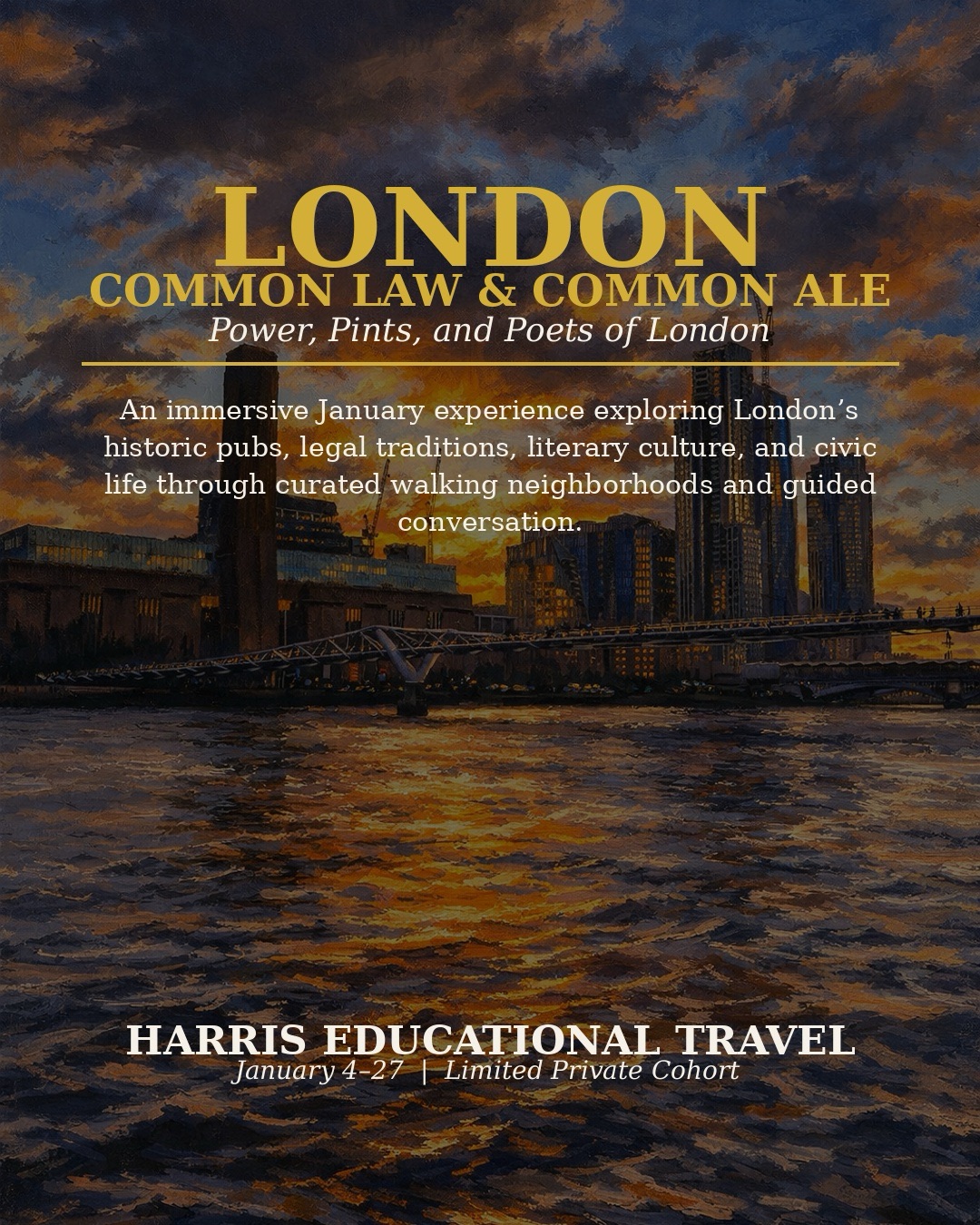
I began researching readings and mapping neighborhoods. I designed a course poster using a photograph I took last December, and seeing the image framed with a title made the idea feel more concrete. I have attached the image below. It moved from a passing interest to something that could, with discipline and intention, take shape.
I do not know whether this will ever become a formal course or even a friends’ vacation. It may remain research, travel, and writing. But it is a rabbit hole I am willingly descending.
We often assume dreams must become programs, credentials, or measurable outcomes to matter. Yet sometimes the value lies in following a question far enough to see what it reveals. Sometimes the work is simply in listening more carefully—to cities, to institutions, to the conversations that shaped them.
So I will ask you something practical. What is the quiet idea you have been circling? What article, book, or conversation has lingered longer than expected? What would happen if you gave it structure and followed it further than convenience allows? If this idea were ever to become something more defined, would you commit to a month of study—walking those streets, sitting in those rooms, asking those questions, and listening for meaning beneath the surface?
It began with a newspaper list, and it continues because I am still listening.
 Sireadh Toileachas
You must be logged in to post a comment.