

What a Mother Is

A Mother’s Day essay about the several mothers in one life — the mother who raised me, the birth mother I found after fifty years, and the woman I chose. Each gave me something the others couldn’t.

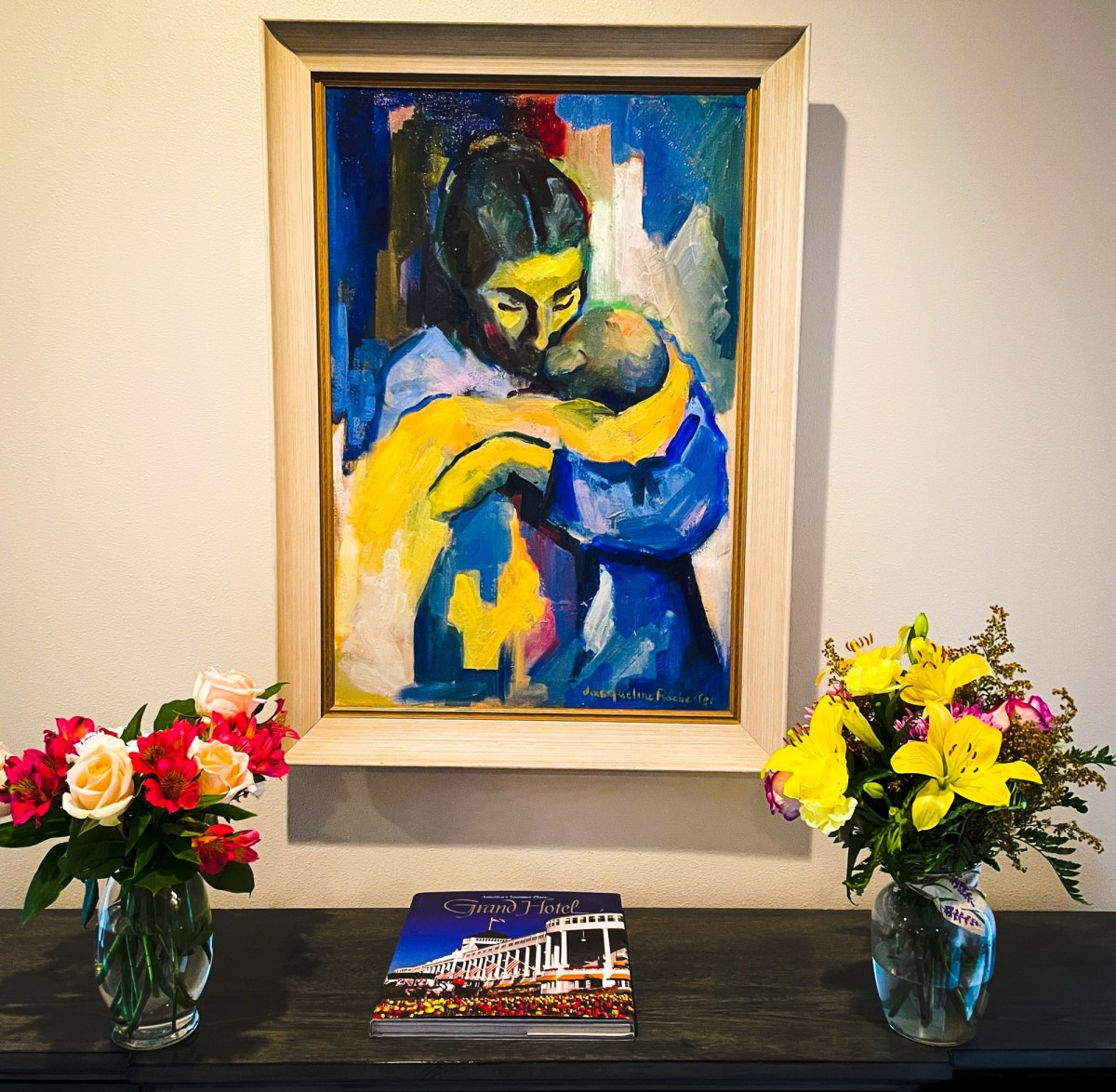
There is a painting in my home that has always been part of my life. A mother holding a child, rendered in bold blues and yellows by a local artist named Jacqueline Rochester. My parents bought it from her when she was a neighbor. Years later, I inherited it. My wife lets me keep it in our home. I am not someone who is moved by a great deal of art. I am moved by this one.

It hangs in the main room. At some point, Mother’s Day flowers ended up on either side of it without anyone planning it. Two bouquets framing a mother and child. It seemed right to leave them there. Tomorrow is Mother’s Day. Early in life, the assumption built into all of it, the cards, the brunches, the flower displays waiting near every grocery store entrance, is that you only have one mother to think about. That is true for a while. Then life keeps moving and the math changes.

There are several mothers in my life, each of whom gave me something the others could not. Every second Sunday in May, I think about all of them.


My mother was everything a young child could want. Caring, compassionate, creative, kind. She made my lunch every day, always my favorite foods. When dinner came, she cooked multiple meals to keep all of us happy. My father, who grew up in a time when food was not always plentiful, would have told us to eat what was in front of us and be grateful. My mother just cooked another meal.

It was early June when a flash flood devastated my hometown. Two hundred and thirty-eight people died in a matter of hours. I was four years old, so my memories are not complete. I remember pieces. Bridges washed out. Cars upside down in department stores. Water and sewer service gone. Close family friends lost their home and lived with us for six or eight weeks. We shared what we had. When we needed drinking water, we drove to an elementary school where tanker trucks had been set up for families. Standing in line filling jugs should have felt strange or frightening. My mother made it feel like an adventure. She made turning on a faucet sound dull by comparison. What four-year-old gets to drive to a school to pick up water?

Looking back now, I realize the same qualities that made her a good mother also made her good on television. “A Woman’s Touch With Mary Ann” was a local talk show, and she was its host. Before tapings, I watched her settle nervous guests with conversation. She made them comfortable. She treated them like they were the most important person in the world, and for those few minutes, maybe they were. She interviewed Phil Donahue, Bob Hope, and, before much of the country understood what it was seeing, Oprah Winfrey. I have sometimes wondered what would have happened if she had been born in a different era or found her way to a bigger market earlier. She never wondered out loud. She may have known it. She never let on.

When South Dakota decided to close the institution where both of my brothers lived, one for twenty-five years and the other for nearly fifteen, my mother went to work. She wrote letters, made calls, cornered politicians, and fought for her sons the way only a mother can fight when she has nothing to lose and everything to protect. In the end, the institution closed anyway. She did not win. But by the end of it, the governor knew exactly who she was. For a mother fighting for her kids, that is not nothing.

In late April and early May, the pasque flower bloomed across our property in the Black Hills. Purple and low to the ground, the first sign winter had finally loosened its grip. Every spring I picked bouquets for my mother without being asked. What I did not know at the time, or perhaps did not care about, was that the pasque flower is the South Dakota state flower, and picking it is technically illegal. I was out there committing crimes for my mother on a seasonal basis. She never once mentioned it. She took those bouquets like they were the greatest gift she had ever received, and she made me feel like maybe they were. Even in college, if I happened to be home at the right time, I still picked them. Some habits survive childhood intact.

She wasn’t there the day I was born, but she is the beginning of every memory I have. She is my original Mother’s Day. She’s gone now. But every May she returns a little.


Maybe that is part of getting older. You realize the people you have lost are not gone in any practical sense. They remain in habits, stories, meals, flowers, holidays, and even the objects sitting quietly in your home. Mother’s Day stopped being simple for me a long time ago because eventually I realized there was another mother thinking about me too.

In the summer of 1968, a twenty-year-old junior at Florida State University arrived in Sioux Falls alone, unmarried, and pregnant. In that era, those facts carried their own social sentence. She lived in a basement apartment for four months. She sewed clothes. She read books. She watched baseball. When the time came, nurses took the baby before she could hold him. She knew only that he was a boy. Then she went home and rebuilt her life. She married, had children, built a career, and kept the secret for fifty years. The hardest days, she later told me, were Christmas, Mother’s Day, and June 15th, the birthday she knew was being celebrated somewhere by someone.

That boy was me.

I found Sandi the way people find things now. A DNA test led to a first cousin match, some internet sleuthing, and eventually, to her. The letter I wrote her took nearly two weeks. I gave her every possible exit because I did not know what waited on the other side. On Christmas Eve 2018, I was standing in a Hy-Vee checkout line, already irritated about something I can no longer remember, when I checked my phone and saw an email subject line that read “Happy Christmas.” I left the cart where it was and walked to my car. I sat there reading the words of a woman I had never met, a woman who had thought about me every Christmas for half a century. At some point I started crying. By the time I drove home, whatever had irritated me ten minutes earlier had completely disappeared.

We met in North Carolina the following spring. She saw me come through the airport terminal and recognized me instantly. To anyone watching, the resemblance probably made the whole thing obvious. She held me the way she had not been allowed to hold me fifty years earlier. For most of my life, adoption had felt abstract to me, almost administrative. A fact more than a feeling. Meeting Sandi rearranged that.

Sandi gave me two things no one else could give. She gave me life. And she gave me up so I could have a better one. I did not understand the size of that decision until I became a parent myself. Both required courage. Both were acts of love. It took me five decades to understand that, but I understand it now.

The painting changed a little after that. For years I had mostly seen comfort in it. After finding Sandi, I started noticing the grip in the mother’s arms.


I did not get to choose the first two women in this story. They came to me the way most things in life do, through circumstance, timing, and decisions made by others. Wanda I chose. She chose me back. What followed has been the great gift of my life, and I have never once found the words adequate to describe her.

Wanda is not a June Cleaver mother. She didn’t bring treats to the ball games. But she made sure her boys got there, on time, with every piece of equipment they needed, which anyone who has ever tried to get a child out the door for a game knows is no small thing. She grew up with only a sister. Boys were not part of her original instruction manual. She figured it out anyway. I’d like to think I helped with the translation.

What she did was harder and quieter than the performing version of motherhood, and she never pretended otherwise. She led by example. She became a role model for her boys without any of them noticing it was happening, which is the only way that actually works.

She protected them, even from me. There were moments when I had something to say and she would suggest another approach. She was right. Every time. Her version of mothering was never hovering. She let her boys figure things out on their own, which takes more restraint than most people realize. When they needed to be challenged, she challenged them. When they needed to be held accountable, she held them accountable. She had a gift I never fully mastered. She could chew them out and motivate them in the same breath. I could only manage the first part.

There is one moment, though, that I come back to more than any other. Our oldest was seven years old when he hit a tree on a ski slope and cracked his skull. We had just found out we were pregnant with our youngest. The doctors were careful with their words. The next 48 hours would be key. That was all they could tell us.

The first night, the two of us folded ourselves into a single recliner in that hospital room, holding each other, not saying much. There wasn’t much to say. Outside the window, the world was going about its business. Inside that room, everything had narrowed down to the sound of a monitor and a seven-year-old’s breathing.

She stayed. The second night, she insisted I go to the hotel. One of us needed real rest, she said. One of us needed to be ready for whatever came next. She had already decided it wasn’t going to be her turn to step back. She sat awake through the night carrying one child while watching over another, and she did it without drama, without complaint, without asking anyone to notice.

We knew he was going to be fine when he started trying to make shapes on one of the monitors, controlling his breath, watching the screen, turning medical equipment into a game. That’s a seven-year-old telling you he’s back. We laughed. On the third day, we went home.

Wanda has been that woman every day for more than twenty-five years. I have a law degree and I teach for a living. I am reasonably good with words. They are not sufficient when it comes to her.


There are several mothers in my life. I am not confused by that. I am grateful for it. Each one of them gave me something the others couldn’t.


Tomorrow is Mother’s Day. There will be flowers and a card, and if I know Wanda, she will insist neither was necessary. Ginger will spend the day underfoot, hoping the occasion calls for a longer walk than usual. Somewhere in North Carolina, Sandi will think about June 15th, except now she knows where the story ended. And I will think about my mother, who spent much of her life making difficult things feel manageable for the people around her.

The painting will still be there when we get back. A mother holding a child between two bouquets no one planned.

What the Day Means

This past weekend, many people celebrated St. Patrick’s Day. A massive snowstorm celebrated back. I missed the parade. I did our taxes.

Fair warning, this one is longer than most. I started writing and couldn’t stop. Hopefully you will indulge. Mothers deserve more attention.

I’m old enough to remember when St. Patrick’s Day was actually celebrated on March 17. Then someone probably decided it conflicted with March Madness and the next thing you know it’s drifting around the calendar like a bar promotion looking for a Saturday. Which, honestly, is all it ever was for most people. I just preferred the fiction.

Here’s what most people don’t know about March 17, nor do they care. It’s not St. Patrick’s birthday. It’s not the day he drove the snakes out of Ireland, and for the record, there apparently weren’t any snakes in Ireland to begin with, which makes that particular miracle less impressive upon reflection. We celebrate March 17 because it’s believed to be the day St. Patrick died, in 461 AD. The Irish built a party around a death anniversary. For me, that’s always been a strange thing to celebrate.

My mom was raised an Irish Catholic, and she loved St. Patrick’s Day the way she loved most things, fully, and with very little patience for people who didn’t. She loved a big party, loved an occasion, and could walk into a room full of strangers and leave knowing everyone. Not in a working-the-room way. In a genuine way. People wanted to be around her because being around her felt like something. She also had strong opinions about most things, and the wisdom to know when to share them, which turns out to be a much rarer combination than it sounds. She died on March 17, 2005, and I’m not a huge fan of this day. But here we are again, twenty-one years later, parade missed, taxes done, and I find myself back at this keyboard trying to figure out what this day is asking of me now and whether I have a better answer than I did the last time.

I’ve written about March 17 twice before. In 2022, I wrote about the sweater. Bright, multicolored, chosen by her on the last morning of her life. She had Parkinson’s for thirteen years and it took most of what made her her, slowly and without mercy. But that morning she picked the right sweater. In 2024, I wrote about standing on a sidewalk the day she died, holding the hand of a two-year-old who had no idea what had just happened and very much wanted to see some floats.

I didn’t want to go to that parade. I wanted to sit somewhere quiet and let the day be what it was. But he wanted to see the parade, and she would have wanted him to see it, and those two things together were enough to get me to the curb. He was completely, unreservedly delighted the way two-year-olds are, without conditions, without any awareness of what it cost the person next to him to be standing there. I was grateful for that. Uncomplicated joy turns out to be exactly what you need when everything else is the opposite of uncomplicated.

That two-year-old is an adult now, my son, and I’ve been thinking lately about how well he and my mom would have gotten along. They would have found each other immediately, compared notes, and spent a considerable amount of time making fun of me together, shamelessly and with great enthusiasm. I would have been irritated. I would have given anything for it.

He walks into a room and something shifts. Not in a loud way, he’s not performing anything. People just want to be near him, want to talk to him, want to know what he thinks. Strangers become less strange around him. He has opinions about everything, and like her, he knows exactly when to use them — and when to put them down in service of the people in the room. He reads the room the way some people read a clock, naturally and without thinking about it. He shows up for people, genuinely, reliably, in the ways that actually count. And he loves a good party, which in this family is less a preference than a personality trait passed down like eye color. And like her, he finds a way to get on camera. For the record, he will be missed this March Madness.

I’ve watched him in rooms the way I used to watch her in rooms, and the feeling is the same. The particular warmth of watching someone who doesn’t have to try to make people feel welcome because it never occurred to them that anyone might not be.

She never met him as the person he became. Parkinson’s had been taking her for years by the time he arrived, and she died when he was two, and the version of her that could have really known him, the sharp, funny, opinionated, life-of-the-party version, was already mostly gone by then. That’s the loss inside the loss, the one that doesn’t get talked about as much. It’s not just that he lost a grandmother. It’s that they lost each other, and neither of them got to know what they were missing.

But here’s the thing I’ve come to understand, slowly and without any dramatic moment of revelation. She didn’t disappear. She just carried forward. The warmth with strangers, the stubbornness, the peacemaking, the way a room feels different when he walks in, the absolute conviction that life is better with more people in it and the volume turned up, that’s not coincidence. That’s her, showing up in the next generation, wearing different clothes.

She would have recognized him immediately. And she would have adored him, and he would have adored her, and together they would have been a handful, and I mean that as the best possible thing I could say about either of them.

Here’s what twenty-one years teaches you. Grief doesn’t leave. It just stops being the loudest thing in the room. In the early years it’s everywhere. It answers your phone, comes to work with you, sits across from you at dinner and says nothing. But if you’re patient with it, and patient with yourself, it eventually learns to share the space. It lets other things back in, joy, distraction, a walk on a good morning. Twenty-one years in, grief and I have an arrangement. It gets March 17. I get the rest of the calendar.

Those words — your mother died — don’t stop being true. They just stop being the only thing that’s true. She loved a big party, she picked the right sweater, and somewhere in a son who lights up rooms and shows up for people and knows exactly when to say the right thing, she is still very much present. You don’t have to believe in anything supernatural to believe that. You just have to pay attention.

Life is worth showing up for. She knew that. Turns out, so does he.

This weekend I missed the parade and did our taxes. She would have had opinions about both. The taxes she would have understood, reluctantly. The missed parade she would have given me grief about for years, which, now that I think about it, would have been its own kind of gift. Happy St. Patrick’s Day, Mom. You would have loved this one. You’d have especially loved who else showed up.

The sweater is still here. And in all the ways that matter, so are you.


This is the third March 17 I’ve written about here. The first two are here and here. New readers, start there. Returning readers, thank you for coming back.

Day 2 Beautiful Things

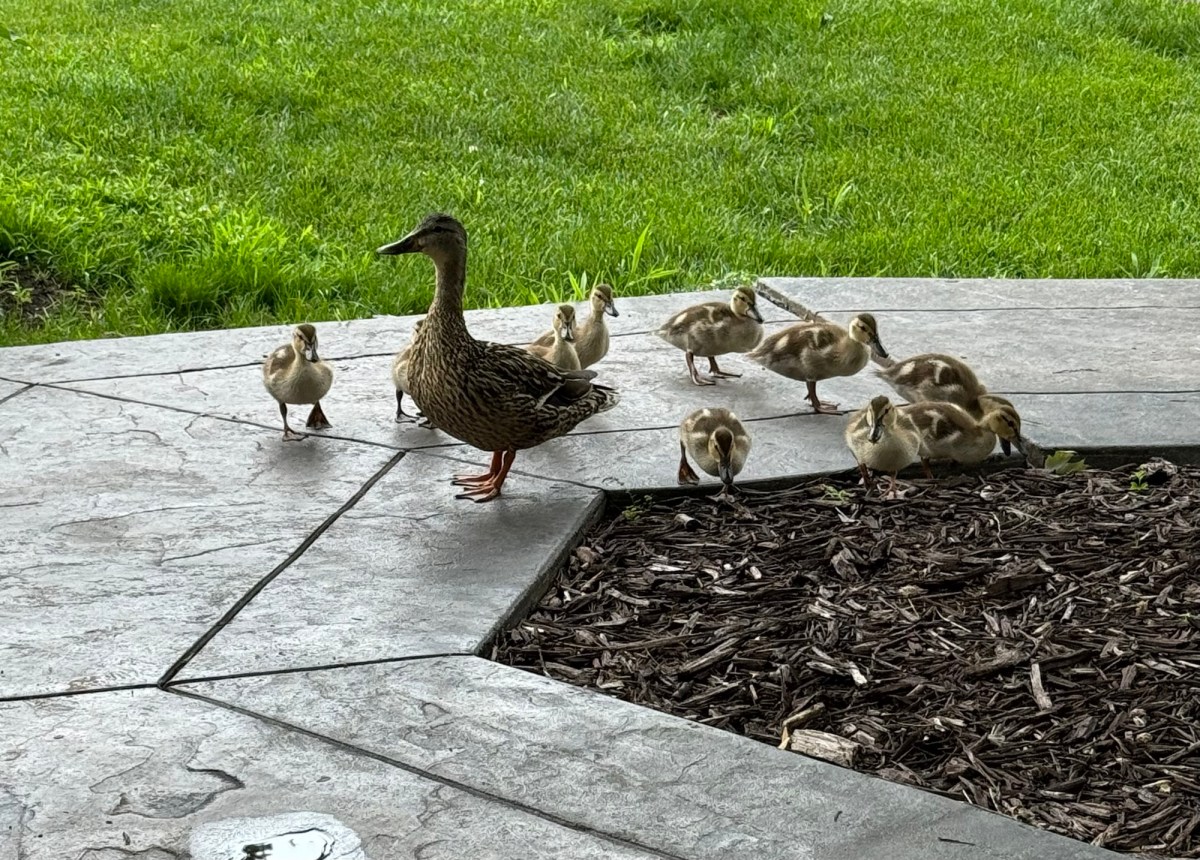
Before I headed back home from the Twin Cities, I was really hoping to fit in a nice outdoor walk. Even though the skies to the north were looking pretty ominous, I decided to brave it. About five minutes into my walk, I reached the pond where I had spotted the ducklings previously (See Day 1 picture). I was so disappointed when I didn’t see them in the water.

As I turned to make my way back to shelter, I caught sight of a lone duck standing near some bushes. Approaching cautiously, I saw the bushes start to rustle. Before I knew it, adorable ducklings were emerging one by one, and I managed to capture a picture of the mother duck and her little ones. Just as I finished, it started to sprinkle, cutting my walk short. Nonetheless, it was a fleeting yet magical moment in an otherwise ordinary day.

March Sadness

March is a month of transformation and growth. It marks the shift from winter to spring, from darkness to light, and from barrenness to fertility. Moreover, for those who follow college basketball, it is the most thrilling three weeks of the year. At one time, I also regarded it as a month of change and evolution.

In March, I am reminded of what was. It marks her entrance into the world, her departure from it, and the cruel echo of her absence that reverberates most profoundly in my soul.

March 17 is a day of festivities, celebration, and joy for many Americans. However, on this day 18 years ago, what began as a typical day quickly turned when I received a call just before 8:00 am saying, “She is not doing very well; you should come.”

As I entered her room, my heart was racing with anticipation and fear. I could see her lying there, frail and weak. Without wasting another moment, I grabbed her hand tightly and whispered, “Mom, I am here.” She took a deep breath and let it out slowly, as if she had been waiting for me to arrive. It was a moment of profound sadness and unspoken love. As I stood there, trying to process what had just happened, I knew I needed my wife by my side. So, I quickly dialed her number and asked her to come.

“I hope you never hear those words. Your mom. She died. They are different than other words. They are too big to fit in your ears. They belong to some strange, heavy, powerful language that pounds away at the side of your head, a wrecking ball coming at you again and again, until finally, the words crack a hole large enough to fit inside your brain. And in so doing, they split you apart.” 

For One More Day – Mitch Albom

The next few hours were a whirlwind of emotions. Phone calls were made to family and friends to let them know about what had happened. Amidst all the chaos, there was one promise that had to be kept. It was St Patrick’s Day and we had promised our two-year-old son that he could watch the parade. Despite the heavy heart, we wanted to make sure he got to experience the joy and excitement of the parade. It was a bittersweet moment, knowing that our little one had no idea of the tragedy that had struck. It would be great if we could all take a break from the chaos and simply soak in the joy of a parade. Sadly, that wasn’t my experience. Even though my son was having a blast, I couldn’t shake off this feeling of emptiness.

As the years have passed since my mother’s passing, I have hoped that the feeling of emptiness would eventually go away. Unfortunately, it hasn’t. Every year in March, I find myself drawn to “For One More Day” by Mitch Albom. One of my favorite quotes from the book is “Sharing tales of those we’ve lost is how we keep from really losing them.” Therefore, I encourage you to share the story of a loved one who is no longer with us as you go about your day today.

Gotcha Day

My parents wanted to have a big family. Prior to my arrival, my parents had four biological children. Three of the four had developmental disabilities with one passing away at three days old. For many reasons, they chose to pursue adoption to expand their family.

I am eternally grateful for all she (and my dad) did in raising me. I never had to worry about clothing, food, or shelter. We took many great vacations. Holidays provided many good memories. Like many families, there were struggles and challenges but I have always known they did the best they could.

Growing up, I asked my mom a lot of questions about my adoption. She tried to answer as many as she could. One day I asked her to tell me how they got me. Was there a store? A mail-order catalog? Did I just show up on their front porch and say hello? She assured me they didn’t get me from a store or a catalog. She said my sister was just teasing when she said I was found under a rock.

All this information is good, but it didn’t answer the question. How did you get me? My mother began to tell the story about how my parents secretly met with a local adoption agency (Lutheran Social Services). My parents told very few people they were considering adoption. Back then, adoption was not a sure thing. She said they asked lots of questions about a lot of things and hoped that they answered correctly so that they could adopt. But she still didn’t answer my question.

So I asked again. How did you get me? She told me they weren’t sure they were going to get me or anyone else. However, one day long before they know of me, my mom went to see a psychic. Given this was the late 60s, I suppose she could have done worse things. She said the psychic looked at her and said “You are going to have another child but this one is different. My mom quizzically asked, “What do you mean?” The psychic looked at my mom and said, “This child will come to you on a plane.” And so it was on this day many years ago, that I flew on a plane with a lady from the adoption agency to meet my family for the first time. Some days are more important than others. This is an important day for me.

Birthdays

For most, birthdays are significant. It marks another revolution around the sun. Another year of thriving, surviving, or something in between. It is a cause for celebration and reflection.

Today I am celebrating another year. The older I get, the more precious these are. We all have friends and family who will not see another birthday.

I have not always been in a celebratory mood on my birthday. If you recall my last post, I talked about the last time I saw my father. Originally, I wasn’t going to stop at the house to see him that night. Why would I stop? After all, I was going to see him the next day when we gathered to celebrate my birthday.

For many years my birthday has been a painful reminder of one of my darkest days. I can still hear the quiver in my mother’s voice as she told me my father had unexpectedly passed away. I remember the spot I was standing when I received word. I was golfing at the time and had to tell the golf group what had happened. We were all young, far too young to experience this.

Since that day, I have worked to use the day not only to reflect and mourn what was lost that day but also to celebrate. So today, I will take time to reflect on my father. The gifts he gave me. I’ll tell him what has happened over the last year. I will honor him.

I will also celebrate. My celebration today will be different. Today, for the first time, I will be celebrating my birthday with the woman the gave birth to me. So today should be a very good day.

Day 29 Gratitude Challenge

It is late November in the upper plains. This means cooler (cold) weather and shorter days. It also means snow. This morning I woke up to snow on the ground. While I am grateful for the beauty and moisture of the snowfall, this is not the focus of the post today.

Today I am thinking about my parents. I am thinking about the decisions and sacrifices they made to provide me with the opportunities I had. Not all are as fortunate as I am. The older I get, the more I realize this.

My parents made sure my basic needs were met. I never had to worry if there would be enough food or if we would have a home. I have always had an abundance of clothes (even if my parents would t buy the new Nike and instead purchased the Keds knockoff!😜)

After years of parenting through the Great Recession and the pandemic, I realize how challenging it must have been for my parents. Were they perfect? No. Did they make mistakes? Probably. However, they did the best they could with the tools they were given. In my opinion, they did a damn great old job. My faults and flaws are of my own making, not theirs. Unfortunately, my parents have passed and I can’t personally thank them for all they did. Perhaps you can take some time to think about your parents today. Think about the sacrifices they made for you. Did they attend your performances, concerts, recitals, games, and/or conferences? If so, they gave up something to be there. If your parents are still living, give them a call or write a letter. Let them know about the good things they did for you.

And one final thing, nothing screams “I love you” more than 70s fashion. The wide white belt and a turtleneck. Enjoy the picture.

Day 22 Gratitude Challenge

A couple of nights ago, Michael J. Fox won the Jean Hersholt Humanitarian award. “The Jean Hersholt Humanitarian Award, an Oscar statuette, is given to an ‘individual in the motion picture industry whose humanitarian efforts have brought credit to the industry.’” It isn’t surprising he won the award.

In the 80s, Fox was one of the top stars in the world. His characters in television and film were iconic. In the early 90s his life changed with a diagnosis of Parkinson’s Disease. Fox kept his diagnosis secret for many years. In 1998, he went public with his diagnosis and ever since has been advocate to find a cure for the disease. Learn more about his efforts at the Michael J Fox Foundation

I took time to watch Fox’s acceptance speech for his award. Watching the speech I became overwhelmed with emotion. I was reminded of his optimism, compassion, and humor. I reflected on his career. I wondered what career had have been. Side note: My favorite movie of his is Doc Hollywood.

Mostly, I was reminded of my mother. Like Fox, in the early 90s, my mother was diagnosed with Parkinson’s Disease. I remember her optimism when Fox went public with his diagnosis. She was hopeful his money and star power would help find a cure in time for her. While the cure did not come in time for my mother, I remain hopeful that a cure will come in my lifetime. I am grateful for the attention Michael J Fox has given Parkinson’s Disease.

He ends his speech with the following words:

“Because my optimism is fueled by my gratitude. And with gratitude, optimism is sustainable.”

The challenge today is to be optimistic. We all have challenges but can we face them with the optimism of Michael J Fox? Use your gratitude to sustain your optimism for a better world.

St. Patrick’s Day

St. Patrick is the patron saint of Ireland. He is often credited with driving the snakes out of Ireland and bringing Christianity to Ireland. Note: According to at least one article, there weren’t any snakes in Ireland – so his act may not be all that impressive. Nonetheless, today, March 17, is the day the Irish (and many who claim to be Irish, wish they were Irish, know an Irish person, or hope someday to go to Ireland) celebrate St. Patrick’s Day. While it was originally a religious feast, it has become secular celebration founded by Irish immigrants in America. Simply put, it’s a big deal and it is a big party.

People all over American celebrate this day. There are parades, green beer, green rivers, and lots of fun. My mom was 1/2 Irish and raised Catholic. She loved St. Patrick’s Day and she loved a big party.

Do you know why we celebrate St. Patrick’s Day today? Why March 17? Was he born on this day? No. Is this the day he introduced Christianity to Ireland? No. Is this the day he drove the snakes out? No. We celebrate this day because it is believed he died on March 17, 461.

I’m not a huge fan of this day. It is a day I will never forget. I was headed out to work when the phone rang (this was back in the days when people had landlines). My wife answered the phone. She quickly made eye contact, mumbled some words into the phone, and held up her hand indicating I needed to stop. Being the ever obedient husband, I stopped. A blank look came over her face. I asked who was on the phone. She said, “It was the nursing home. She said your mom isn’t doing well and you should get there soon.”

My mother had been in the nursing home for a couple of weeks. She was recovering from surgery to repair a broken hip. Additionally, she had Parkinson’s Disease. She was no longer the smiling and engeretic person she once was. For 13 years, Parkinson’s Disease had ravaged her body and her mind. We knew the end was near.

I drove quickly to the nursing home. When I walked into her room, I immediately noticed what she was wearing. She wore a very bright multicolored sweater. If you knew my mother, this sweater matched her personality perfectly. My mom had picked the sweater to wear. It was the perfect sweater for her to wear to big party. I think she knew.

Also in the room was a nurse. The nurse said my mom was having problems breathing. My mom was laying in her bed. I sat down next to her. I held her hand and let her know I was there. And then, it happened. All the stress and tension that Parkinson’s Disease had put in her body went away. My mom’s Parkinson’s mask disappeared. She was so peaceful and relaxed. I had not seen her that way in years. I felt a warm rush of calm serentiy fill the room. But then it hit me, my mother had passed away. She was gone and just like St. Patrick, it was March 17.

I kept the sweater and found it again the other day. It reminded me of what a bright star my mom was. It is pictured in this post. So as you celebrate your Irish heritage today, raise a glass to honor my mother, raise a glass to honor your mother, and raise a glass to honor St. Patrick.

The importance of stories

This picture is of my mom and her dad.  There is no date on the picture, but she looks about 2 or 3 years old. Even at this age, her smile lit up a room. I never met her dad. He died before I was born. Yet from the stories my mom told and this picture, it is clear the two had a special bond.

Today is my mom’s birthday. She would have turned 90 years old. It has been 17 years since I celebrated a birthday with my mom. I wish she could see how great her grandkids have turned out.

I think about my mom every day. Around her birthday, I think about her a lot. March is the month in which she was born and died. There are so many stories I could tell about my mom.  Like the time I fell out of the car and she kept on driving – she hated it when I told that story. Or how sometimes when she and my dad would argue, she would begin to cry and through the tears say “Well, Shit!” and the argument was over. Or how about time she kept sneaking chocolates to my youngest son when she was in the hospital for the last time.

On her last birthday, I could tell mom was tired. Life and Parkinson’s disease had taken a toll on her mind and body. She was no longer the active vibrant woman of my youth. Yet, there was an occasional twinkle of mischief in her eyes. She wanted to say things but her body and mind wouldn’t let her. But through it all, she smiled when we sang happy birthday. She ate her cake and tolerated the grandchildren running around the room. This is how I remember her last birthday.

Mitch Albom wrote, “Sharing tales of those we’ve lost is how we keep from really losing them.” In this post, I shared a couple of stories about my mom. So today, take a moment and share a story about someone you love. If you have a story about my mom, send it to me, I would love to hear it. If your parents or grandparents are still living, call or visit them. Let them tell you a story that you can carry with you forever.