

This past weekend, many people celebrated St. Patrick’s Day. A massive snowstorm celebrated back. I missed the parade. I did our taxes.
Fair warning, this one is longer than most. I started writing and couldn’t stop. Hopefully you will indulge. Mothers deserve more attention.
I’m old enough to remember when St. Patrick’s Day was actually celebrated on March 17. Then someone probably decided it conflicted with March Madness and the next thing you know it’s drifting around the calendar like a bar promotion looking for a Saturday. Which, honestly, is all it ever was for most people. I just preferred the fiction.
Here’s what most people don’t know about March 17, nor do they care. It’s not St. Patrick’s birthday. It’s not the day he drove the snakes out of Ireland, and for the record, there apparently weren’t any snakes in Ireland to begin with, which makes that particular miracle less impressive upon reflection. We celebrate March 17 because it’s believed to be the day St. Patrick died, in 461 AD. The Irish built a party around a death anniversary. For me, that’s always been a strange thing to celebrate.
My mom was raised an Irish Catholic, and she loved St. Patrick’s Day the way she loved most things, fully, and with very little patience for people who didn’t. She loved a big party, loved an occasion, and could walk into a room full of strangers and leave knowing everyone. Not in a working-the-room way. In a genuine way. People wanted to be around her because being around her felt like something. She also had strong opinions about most things, and the wisdom to know when to share them, which turns out to be a much rarer combination than it sounds. She died on March 17, 2005, and I’m not a huge fan of this day. But here we are again, twenty-one years later, parade missed, taxes done, and I find myself back at this keyboard trying to figure out what this day is asking of me now and whether I have a better answer than I did the last time.
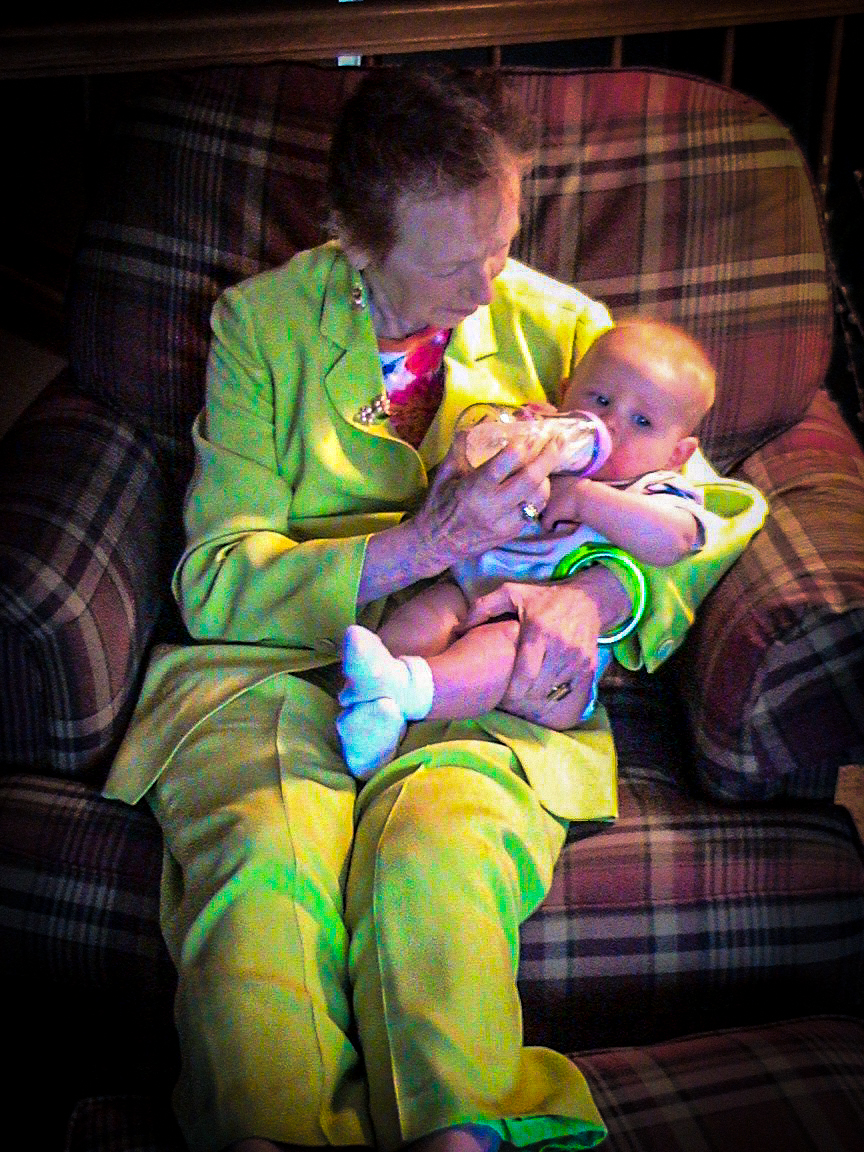
I’ve written about March 17 twice before. In 2022, I wrote about the sweater. Bright, multicolored, chosen by her on the last morning of her life. She had Parkinson’s for thirteen years and it took most of what made her her, slowly and without mercy. But that morning she picked the right sweater. In 2024, I wrote about standing on a sidewalk the day she died, holding the hand of a two-year-old who had no idea what had just happened and very much wanted to see some floats.
I didn’t want to go to that parade. I wanted to sit somewhere quiet and let the day be what it was. But he wanted to see the parade, and she would have wanted him to see it, and those two things together were enough to get me to the curb. He was completely, unreservedly delighted the way two-year-olds are, without conditions, without any awareness of what it cost the person next to him to be standing there. I was grateful for that. Uncomplicated joy turns out to be exactly what you need when everything else is the opposite of uncomplicated.
That two-year-old is an adult now, my son, and I’ve been thinking lately about how well he and my mom would have gotten along. They would have found each other immediately, compared notes, and spent a considerable amount of time making fun of me together, shamelessly and with great enthusiasm. I would have been irritated. I would have given anything for it.
He walks into a room and something shifts. Not in a loud way, he’s not performing anything. People just want to be near him, want to talk to him, want to know what he thinks. Strangers become less strange around him. He has opinions about everything, and like her, he knows exactly when to use them — and when to put them down in service of the people in the room. He reads the room the way some people read a clock, naturally and without thinking about it. He shows up for people, genuinely, reliably, in the ways that actually count. And he loves a good party, which in this family is less a preference than a personality trait passed down like eye color. And like her, he finds a way to get on camera. For the record, he will be missed this March Madness.
I’ve watched him in rooms the way I used to watch her in rooms, and the feeling is the same. The particular warmth of watching someone who doesn’t have to try to make people feel welcome because it never occurred to them that anyone might not be.
She never met him as the person he became. Parkinson’s had been taking her for years by the time he arrived, and she died when he was two, and the version of her that could have really known him, the sharp, funny, opinionated, life-of-the-party version, was already mostly gone by then. That’s the loss inside the loss, the one that doesn’t get talked about as much. It’s not just that he lost a grandmother. It’s that they lost each other, and neither of them got to know what they were missing.
But here’s the thing I’ve come to understand, slowly and without any dramatic moment of revelation. She didn’t disappear. She just carried forward. The warmth with strangers, the stubbornness, the peacemaking, the way a room feels different when he walks in, the absolute conviction that life is better with more people in it and the volume turned up, that’s not coincidence. That’s her, showing up in the next generation, wearing different clothes.
She would have recognized him immediately. And she would have adored him, and he would have adored her, and together they would have been a handful, and I mean that as the best possible thing I could say about either of them.
Here’s what twenty-one years teaches you. Grief doesn’t leave. It just stops being the loudest thing in the room. In the early years it’s everywhere. It answers your phone, comes to work with you, sits across from you at dinner and says nothing. But if you’re patient with it, and patient with yourself, it eventually learns to share the space. It lets other things back in, joy, distraction, a walk on a good morning. Twenty-one years in, grief and I have an arrangement. It gets March 17. I get the rest of the calendar.
Those words — your mother died — don’t stop being true. They just stop being the only thing that’s true. She loved a big party, she picked the right sweater, and somewhere in a son who lights up rooms and shows up for people and knows exactly when to say the right thing, she is still very much present. You don’t have to believe in anything supernatural to believe that. You just have to pay attention.
Life is worth showing up for. She knew that. Turns out, so does he.
This weekend I missed the parade and did our taxes. She would have had opinions about both. The taxes she would have understood, reluctantly. The missed parade she would have given me grief about for years, which, now that I think about it, would have been its own kind of gift. Happy St. Patrick’s Day, Mom. You would have loved this one. You’d have especially loved who else showed up.
The sweater is still here. And in all the ways that matter, so are you.
This is the third March 17 I’ve written about here. The first two are here and here. New readers, start there. Returning readers, thank you for coming back.


 Sireadh Toileachas