The tickets were sorted. Now came the long way home.
Last week I wrote about the walk from Waterloo to Paddington, four miles across London on a free day while my students attempted to set the Guinness record for pub crawling. I had gone to Paddington for train tickets to Henley, but the walk back was never going to be the same walk in reverse. London had changed by then.
By the time I started back, the city was louder, the parks were fuller, and the quiet errand had become something closer to a full day’s walk. I was not trying to make good time. I was trying to notice. I reentered at the Italian Gardens, the formal ornamental garden at the northern tip of the Serpentine where Hyde Park and Kensington Gardens meet. The boundary between the two parks is blurry here, which is part of the charm. Stay west and you are in Kensington Gardens. Go east and you are in Hyde Park.
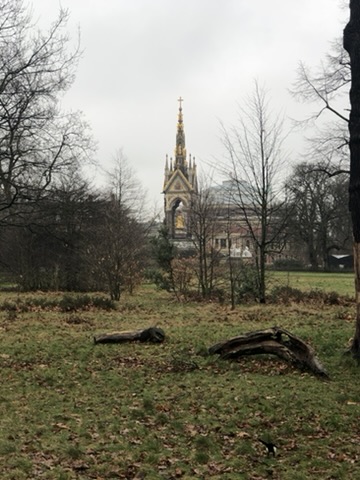
I usually went west first, toward Kensington Palace. The Albert Memorial comes into view on your left, an elaborate gilded monument with Royal Albert Hall rising behind it across the road. Then I would turn back east along the Serpentine. If instead you head south from the Italian Gardens, the path takes you past the Peter Pan statue, which has been standing there since 1912 and still draws people who stop longer than they expected to. Either way, you end up along the Serpentine, which by then was an afternoon walk, with the park busier, the light different, and my feet beginning to understand London better than my map did.
Keep your eyes up while you walk. Hyde Park has parakeets, bright green ones, darting through the trees. They are not native to England, and nobody knows for certain how they got there. The stories range from Jimi Hendrix releasing a pair on Carnaby Street in the 1960s to escapees from a film set. The truth is unclear. The birds are not. Eventually the park releases you. You come out near the back side of Buckingham Palace, which is where I would duck through rather than past the front.
Walking behind the palace, you find yourself in a neighborhood marked by a surprising number of international flags, the kind that signal embassies and consulates. If you know your flags, this is a good stretch to test yourself.
Eventually the consulates of Belgravia give way to Victoria, where each street seems to have been designed by a different century. Turn a corner and you move from Edwardian to Georgian. Turn another and you are in late Victorian. Turn one more and someone has dropped a modern building in without asking. London has always been like that. It should not work. It does.
The street names alone are worth the detour: Petty France, Buckingham Gate, Queen Anne’s Gate. Tucked among the townhouses are pubs with names that feel like they belong in a novel: The Old Star, The Adam and Eve, The Two Chairmen, The Feathers, The Phoenix. More than once I stopped for a late lunch, an afternoon snack, or a local beer. Nobody was in a hurry. Neither was I. Eventually I settled the bill, stepped back outside, and kept walking. A few blocks later I reached into my jacket to make sure the tickets were still there. They were. A few days from now, those tickets would put my students on a train to Henley, and me a few hours closer to someone I had been looking forward to seeing since before the term began. Then, without much warning, Westminster Abbey appeared above the roofline as if it had simply decided to be there. It stopped me every time. It still does.
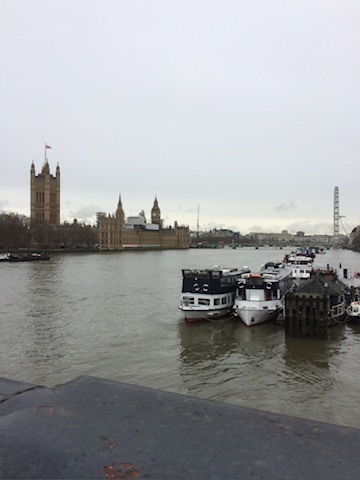
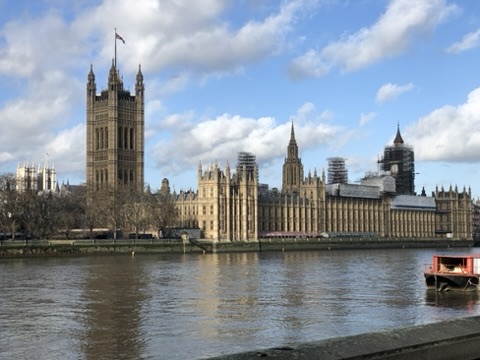
I usually worked my way behind Westminster Abbey and then to Victoria Tower Gardens, a small park tucked at the south end of the Parliament building that most visitors never find. The gardens take you naturally down to Lambeth Bridge, which is nothing like Westminster Bridge and better for it.
Earlier in the day I had crossed Westminster Bridge, the green one, the postcard one, the one crowded with selfie sticks and people trying to prove they had been there. Lambeth Bridge is different. It is painted a deep red, supposedly to echo the benches of the House of Lords, just as Westminster Bridge echoes the green benches of the House of Commons. Maybe that is true. Maybe it is just one of those stories London tells because it sounds right. Either way, from the middle of Lambeth Bridge you get Parliament and Westminster Abbey without the crowd. The same landmarks, but from a quieter angle.
Once across, you have a choice. Head toward Lambeth Palace, the official London residence of the Archbishop of Canterbury and reportedly so for 800 years. I never saw him there. Or turn and walk along the Thames toward Westminster Bridge.
I usually took the river. The walk along the Thames after Lambeth Bridge is quiet and thoughtful in a way the outbound journey never is. The city has changed pace by now. Fewer people, a handful of street vendors, but no hustlers, no tour groups, and no one performing for anyone. The river moves beside you, and London lets you alone for a while. You follow the river until Westminster Bridge comes into view, and that is your signal to turn. From there it is a short walk back through the familiar landmarks: past the London Eye, back through Leake Street, up through Lower Marsh, and finally the hotel. By the time you walk through the door, you have covered nine to ten miles of one of the great cities in the world, more if you wandered, and your feet know it.
When I got back to the hotel, I carefully sorted and stored the tickets for the trip to Henley. After nine to ten miles of walking, I was ready to join my students for a pint at a nearby pub. Most of them had a head start. Though I should say, some of them had actually used the day the way I had hoped. A few went to the V&A Museum. Others made the pilgrimage to Abbey Road. There were always a couple who did something Harry Potter related, which I understood completely. Many went to pubs. We compared stories about our day.
I told them I had walked to Paddington to get the tickets to Henley. Then I told them a little about my friend. The woman who had lived with our family during the Silver Jubilee. The one who had made my life immeasurably better. Not the whole story. That would come later. For now, it was enough that Henley was getting closer.

 Sireadh Toileachas