
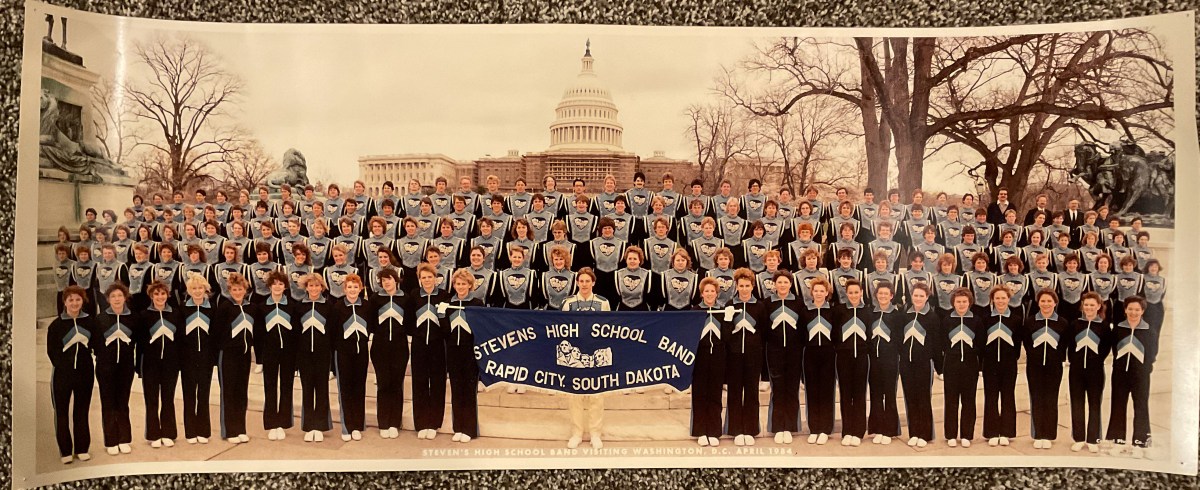
We are downsizing, and my wife has asked me to do a bit more of the sorting than I’d prefer. That’s how I ended up on the floor of a closet with a box of photographs across my lap, the kind of box you mean to go through quickly and never do. Many of them were from high school. There were pictures of family and friends, but a surprising number were from band. We were standing on football fields, sitting on buses, and wearing uniforms I’d forgotten we ever wore. The faces of the people I spent those years beside were all there, and looking at them made me think about the man who’d stood behind nearly all of it.
Mr. Winter was one of the most influential people in my life. I hadn’t thought about him in a while. Once I did, I couldn’t stop.
I came to band the way many children come to things. I wanted to belong before I fully understood what I was joining. My sister was already in high school, and one of her best friends played saxophone. The band at our high school had been good for years. People came to football games as much for the band as for the team, and more than a few left after halftime, once the show they’d come to see was over. It was a program with a reputation, and even as a child I understood that being part of it meant something.
It wasn’t just the locals who thought so. While I was in the band, it received the Sudler Flag, an award recognizing the finest high school bands in the country, and ours was the first in the state to earn it. The honor reflected what the program had built long before I arrived, but I was there when it came, and that felt special. It was exactly the kind of thing a child wants to be part of, even before he understands the work required to belong there.
What captured my imagination most, however, was the traveling. Every third year, the band went somewhere significant for a competition or a tour. My sister’s friend had gone to Europe, which seemed impossibly glamorous to a fifth grader growing up where I did. The band would later become the first from our state to march in the Rose Bowl parade, and during my sophomore year we were scheduled to travel to Washington, D.C., for the Cherry Blossom Festival. I didn’t know any of those destinations when I chose the saxophone. I knew only that if I joined and stayed long enough, I’d eventually get on that bus and go somewhere that felt much larger than the world I knew.
So I chose the saxophone and imagined the rest would follow. I’d become part of something great, take the trip, and collect the kind of experience that seemed to belong to older and more interesting people.
The problem was that I didn’t enjoy band, at least not in junior high. I didn’t like to practice, it didn’t come naturally to me, and as a result I wasn’t very good. It was a reliable formula. I avoided the work, remained bad at the thing, and then used being bad as further justification for avoiding the work. Junior high is difficult enough on a child’s confidence. Your body is changing without consulting you, and whatever certainty you possessed a few years earlier quietly disappears. Practicing at home, where someone might hear me, wasn’t something I wanted to do.
It didn’t help that my father was both a perfectionist and a genuinely gifted musician. The person most likely to hear me could also hear exactly what I was doing wrong. So I didn’t practice, and because I didn’t practice, I remained at or near last chair for most of those years. There is no hiding a thing like that. The seating chart announces it for you.
By the end of junior high, I’d developed a plan. I’d stay in band through my sophomore year, take the major trip, and then quit. The band was going to Washington, D.C., and I’d already endured too many uncomfortable years to walk away before the reward. In my mind, the arrangement was settled. I’d hang on long enough to see Washington and then put the saxophone away for good. The trip had always been the goal. Band was simply the price of admission.
None of this was a plan I shared with anyone. So when I went to my parents, sooner than my own schedule called for, and told them I wanted to quit outright, I wasn’t really asking. I knew what they’d say. It was the kind of thing teenagers do, rattling a door to see whether it’s still locked. It was.
My father believed in what music education could do for a person, and he wasn’t prepared to let me leave simply because I was frustrated. He was a surgeon, and surgeons aren’t inclined to reopen a decision once they’ve closed it. I resented the rule at the time, but he was right. Had he allowed me to quit when I wanted to, the story would have ended there, somewhere near the bottom of a junior high seating chart.
My mother was different. She looked for another solution, and the solution she found was private lessons. Somehow, my parents persuaded Mr. Winter to teach me. He didn’t take many students, but once a week for the next three years, he took me.
I’ve never known exactly why he agreed. Perhaps he saw something in me, although there wasn’t much evidence available at the time. Perhaps it was simply a little extra money on the side. Years later, after I became a teacher myself, I came to think there was another explanation. Good teachers don’t reserve their effort for the students who make teaching easy. They work with the student sitting in front of them and try to move that person forward. Mr. Winter had done that for the students who came before me, and he’d do it for those who came after, because that was the kind of teacher he was.
His house wasn’t far from the school, an ordinary home with a black trumpet standing near the entrance. The trumpet was his instrument. The saxophone, unfortunately for both of us, was mine. The lessons took place in a small office where we warmed up with scales in different keys and then worked through whatever the band was rehearsing. I’d play a passage, and he’d interrupt. A missed note, a rhythm I’d gotten wrong, or a phrase that bore only a passing resemblance to the music on the page, and we’d stop.
He figured out fairly early that I learned by ear. If I heard something played correctly, I could usually imitate it. He’d pick up the trumpet, play the phrase, and have me play it back to him. Sometimes he made me count the rhythm aloud, which felt childish but worked. He could become frustrated. I could see that. But he never once let contempt into that room. He corrected me without humiliating me. He didn’t get angry, and he didn’t make me feel small, which wasn’t always how correction felt at home.
Don’t mistake his patience for softness. In that small office, and later in the band room, he pushed me harder than I’d have pushed myself. He was demanding, structured, and occasionally intimidating. Some people thought he bordered on authoritarian. I eventually came to believe there was an important difference between an authoritarian and a disciplinarian. An authoritarian pushes for control so that the person in charge remains at the center. A disciplinarian pushes the group, and every person within it, toward excellence.
With Mr. Winter, it was never about him. It was about us. He believed that through discipline, hard work, and consistency we could become great, and he ran the room like a man who meant it. He demanded excellence, and we wanted to give it to him. I wanted to be excellent, and I think most of the others did too.
I remember him telling us once that we needed to be at the practice field by five o’clock. He let that sit for a moment, and then he explained what he actually meant. If you arrived at five, you were late. If you arrived at four fifty-five, you were also late. You were expected to plan for the unexpected, the flat tire, the fender bender, the train that might hold up traffic, whatever might keep you from where you needed to be. To this day, when I have somewhere to be, I arrive fifteen to twenty minutes early. He wasn’t really teaching us about punctuality. He was teaching us that showing up late let down everyone else who had already arrived on time.
Even when we were certain we’d improved, he found the small thing still wrong. The spacing was off in the marching formation. The trumpets were too loud in the jazz band. Someone had missed an entrance. The clarinets needed to give more. Everything was held together by structure, and all of us were accountable to it. There was no false praise in that room. If he told you something was good, it was good, which is exactly why it mattered so much when, on the rare night we truly put everything together, he’d tell us the performance had given him goosebumps. He wasn’t a man who traded casually in that kind of praise, so it meant the world. You worked an entire season hoping to hear one sentence like that. I understand now that he tended to say it in the day or two before a concert or a competition, which meant it was less a report on what had already happened than his way of telling us we were ready.
I don’t know exactly when the lessons began to work. There was no single morning when I woke up able to play. The improvement arrived quietly. Through the challenge system, I’d sit across from the player ahead of me, and we’d compete for the chair. I began to move up, one seat at a time. I moved out of last chair, climbed through the ranks, and eventually moved out of the lowest band.
One of those moves meant more than the others. Throughout junior high and the beginning of high school, I’d played the second part, the harmony, which never made much sense to my ear. I wanted the melody, the line the song seemed to be built around. When I finally won my way onto a first part, it felt like more than another chair. It was the difference between singing lead in a rock band and standing in the back with the other harmonizers. I was carrying the tune now.
As I moved upward, something happened that mattered more than the seating chart. I gained confidence. For the first time, I began to enjoy not merely belonging to the band, which was all I’d originally wanted, but the music itself. I enjoyed reading it, interpreting it, and performing it. The thing I’d spent years avoiding became something I looked forward to.
I started practicing. The high school had small practice rooms, and that was where I did most of it. At home, I learned to find times when the critical ears were elsewhere. I was finally doing what my father had always hoped I’d do, but I was no longer doing it because he expected it. I was doing it because I wanted to improve.
The trip to Washington came during my sophomore year. For years, it had been the finish line. I’d planned to endure band long enough to take the trip and then quit. By the time we returned, however, I no longer wanted to leave. The lessons had changed the bargain. They had taken something I was merely surviving and turned it into one of the greatest experiences of my life.
Sometime during my junior year, I made the permanent jump from the junior varsity band, the concert band, to the varsity, the symphonic band. Make no mistake, symphonic was the A-team, the place you wanted to be. The move came with a small indignity. Climbing into a stronger band meant returning near the bottom, which put me back on the second part again. This time it didn’t bother me. I’d stopped keeping score of first parts and second parts and started caring about the music. I trusted that if I continued to work, the climb would come.
By my senior year, I reached first chair. I’d gone from worst to first, although I’d never describe myself as an outstanding musician. I was good, and I felt good about what I could do. Somewhere along the way, I’d come to love all of it: the band, my friends, the performances, the trips, the music, and the life that surrounded it. That was the real distance traveled, farther than the chairs could measure.
That same year, Mr. Winter gave me another responsibility I hadn’t seen coming. Before each concert selection, I stood in front of the audience and explained what they were about to hear. He wrote out the introductions and made me rehearse them until they were right, the same way he made me practice everything else. The boy who’d spent years hoping no one was listening was now the person he placed in front of the audience to speak.
After graduation, I thought about playing in college but decided against it. I didn’t believe I had enough ability to justify the time it would require while keeping my grades where they needed to be, so I let it go. I still have the saxophone. During the current purge, I’ve considered selling it so that another child might get from it what I eventually did, later than I should have, but not too late.
College led to law school, and through both I found myself relying on lessons Mr. Winter had taught me without ever intending them to apply beyond the band room. I learned the discipline required to work toward a goal, the value of preparation and repetition, and the importance of refusing to settle for work that was merely adequate. Nearly a decade after I graduated from high school, his influence was still shaping what I did every day, which is probably why running into him in a hallway in Madison, right after I argued my first case before the state Supreme Court, felt like something closing a circle.
The court was holding a traveling session that year, hearing cases in a college theater with members of the public seated in the audience. I was nervous. When the argument ended and I walked into the hallway, Mr. Winter was standing there.
He told me he was in town to fish and had seen that the court was holding a session, so he decided to come. I don’t think he drove to Madison specifically to see me. I suspect he noticed my name and decided to stay, which is somehow the better version of the story.
We spoke for only a minute. He told me I’d done a good job, and then he said something I’ve remembered ever since. You were always a good speaker, he told me. He was right. Years before I stood in a courtroom, he’d placed me in front of concert audiences and made me practice speaking until I could do it well. Like a good teacher, he’d recognized something in me and pushed me to develop it long before I understood that was what he was doing.
We talked briefly about where life had taken us. He said it was good to see me, and then we went our separate ways. That was approximately thirty years ago, and I believe it was the last time I saw him.
I cherished those three years in that band as much as almost anything else in my life. I’m still in touch with a few of the people who stood on those fields and stages beside me, though I’ve lost touch with most of them. A fortieth reunion is coming this fall. I don’t know yet if I’ll go. But if I knew Mr. Winter would be there, I’d give serious consideration to making the three hundred fifty mile drive to see him.
Mr. Winter is still alive. He’s in his nineties now and, as far as I know, still lives in the same house with the small office where I sat across from him all those years ago. I can’t repay him for what he gave me. I’ve tried to carry the lessons forward, applying them to my own life and passing them along when I later stood in front of students of my own. What I never did was thank him the way he deserved to be thanked.
Perhaps he’ll read this. Perhaps someone back home who still knows him will see it and place it in front of him. I hope so, because this is the thank you I should have given him a long time ago. Thank you for taking on a student who wasn’t very good and didn’t yet care enough to become better. Thank you for demanding more without making me feel small. Thank you for seeing something in me before I knew it was there. Thank you for turning an experience I intended to abandon into one of the defining experiences of my life.
It began with a box of photographs and all those faces from band. Mr. Winter appeared in only one of them, and even there he was just a figure in the background. But he was in every picture, all the same.