2026 arrived quickly and with a certain enthusiasm for chaos.

Some seasons arrive quickly, carrying more than we planned to unpack.

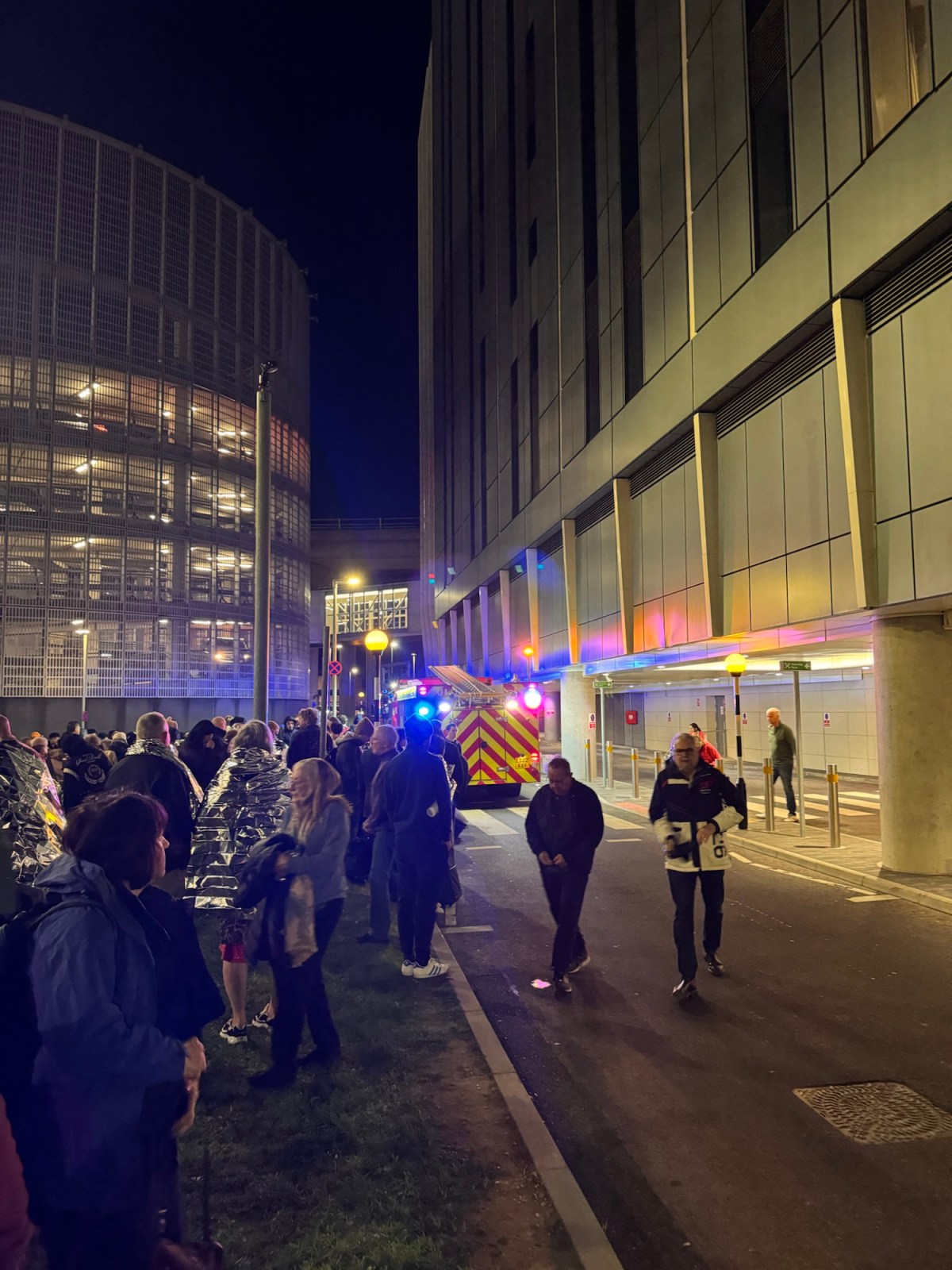
It was probably best that I didn’t subscribe to Dry January. I should have known the year was going to be a beast when, less than six hours into it, I was in a hotel and the fire alarm went off—and it wasn’t a drill. This is not how you want to meet a new calendar year. Then the gods of fate said hold my beer when four members of my immediate family experienced “medical” events, including three emergency room visits, three hospitalizations, and a surgery. January came in like it had a clipboard and a very aggressive agenda.

Along the way, I learned—or was reintroduced to—phrases like spinal stenosis, Clostridioides difficile, colitis, concussion, and tympanostomy. My medical vocabulary has expanded more in a few weeks than it had since I snuck into my dad’s home office and leafed through his copies of the Journal of the American Medical Association and Annals of Surgery. I may not have earned a degree, but I’ve at least qualified for a certificate. Possibly laminated.

And in case you hadn’t noticed—perhaps because you, too, were distracted by sirens and discharge papers—there is also a lot going on in the world.

Much of my attention has been on the Twin Cities. My family has been impacted. My friends have been impacted. This hits close to home. I watch and wonder how we got here. Early in my professional life, I spent time both prosecuting and defending criminal cases, which means I have a reasonably high tolerance for human dysfunction. Even so, many of the things I now see and read—especially through that lens—are genuinely shocking. Not shocking in a cinematic way. Shocking in a quiet, procedural, this-is-how-it’s-written-down way.

Current events often pull me back to what I studied in college, back when you could take courses that wrestled directly with uncomfortable truths instead of politely circling them. I took more than one class focused on the Holocaust and similar atrocities. As a senior, I enrolled in Light in the Darkness: Courage and Evil in the Twentieth Century. The course focused heavily on the Holocaust. At the time—and still—I struggled with how something so terrible could happen.

We studied life in Nazi Germany. We discussed Anne Frank. We read Elie Wiesel. We also read Heart of Darkness by Joseph Conrad, a book I still don’t fully understand, which puts me in excellent company that includes most honest readers.

Though my memory of the course is imperfect—college being a long time ago and optimism being a powerful anesthetic—several moments stand out. Perhaps most significantly, we took a “field trip” to Minneapolis. While there, we attended a concert at Orchestra Hall, spent an evening at the Chanhassen Dinner Theatre, and visited a Holocaust museum.

But there is one experience I will never forget.

We met Holocaust survivors.

One woman had been sent to Auschwitz. She told us her story patiently and answered our questions with care. Then, in a moment that permanently fixed itself in my memory, she rolled up her sleeve and showed us the tattooed number on her arm—a mark that had been there for more than forty-five years. No build-up. No warning. Just history, sitting across from us in a folding chair.

She spoke about the days leading up to liberation. She described the moment she knew she was free. She was offered a ride to the nearest supply camp roughly a mile away. She declined. This, she said, was her freedom walk. She walked the entire distance, stopping frequently because she was so weak. She had to keep her head lower than her heart to avoid losing consciousness.

She spoke about her first bite of food—and the danger of eating too much, too quickly—because her body had essentially shut down. She knew she was close to death, close enough to feel it in a practical, unsentimental way, but she willed herself to live. She told us she kept repeating to herself: Not today. Today I am free.

Someone asked her how she felt about Germany now. Very calmly, she explained that she bore no ill will toward Germans born after World War II. They were not responsible, she said; they carried the scar, not the guilt. But Germans who were present at the time—who did nothing and said nothing—were responsible for the atrocities.

There was no theatrics. No slogans. No grand conclusions. But the emotion, the pain, and the anger hung in the air, doing what facts sometimes do when delivered by someone who earned them the hard way.

I don’t remember her name. I remember her message.

Make sure this never happens again.

Since then, I have found myself returning to her words. I wonder—perhaps naively—whether a similar regime could ever arise in my own country. I keep reaching the same conclusion: yes, it absolutely could. Not because of any single current event, but because we are human, and humans have repeatedly shown a remarkable capacity for atrocity, especially when paperwork is involved.

I also arrive at a more uncomfortable conclusion: there is no way to know how I would respond.

Would I recognize what was happening in real time? Would I speak out? Would I protect those being targeted? Or would I choose personal or family safety over principles and values? Would I convince myself that compliance was temporary, reasonable, or necessary? History suggests these decisions are rarely dramatic. They are incremental. Transactional. Rationalized. Often explained afterward with excellent grammar.

And that, more than anything, troubles me.

What unsettles me most is not that the news feels alarming—news often does—but how quickly alarming things begin to feel normal. A headline that stops you cold on Monday becomes background noise by Friday. By the following week, it’s something we summarize with a shrug and a sentence that starts with, “Well, I guess that’s just how things are now.” That is usually the point at which questions about how we would respond quietly turn into questions about what we are willing to tolerate.

What we are willing to tolerate is shaped, in no small part, by what we understand to be our rights in the first place. When those boundaries are clear, normalization has limits. When they are vague, everything becomes negotiable. Fortunately, we do not have to define those boundaries from scratch or rely solely on instinct and outrage. We have a well-worn roadmap. It is called the Constitution. It does not prevent abuse or guarantee wisdom, but it does establish a baseline—certain rights meant to exist regardless of convenience, popularity, or who happens to be in power.

At its most basic level, that baseline includes the right to move through daily life without harassment; the right not to be stopped and required to justify one’s existence; the right to be free from restraint, harm, or worse based on minor suspicion; and the right to observe authority without becoming its target. It includes the right not to be threatened, exploited, confined, or erased—and the right to speak freely, worship freely, and to have a home that remains a refuge rather than a checkpoint.

None of this is abstract. None of it lives safely in textbooks or court opinions. It unfolds in real time—often within hours: a traffic stop at dusk, a crowd forming, a knock before sunrise, a decision made quickly by someone with power and limited restraint. At that speed, there is no meaningful pause, no appeal, no rewind. Due process—the idea that power must justify itself before it harms—only protects people if it exists before force is applied, not afterward. If this feels distant or exaggerated, it is usually because it has not yet arrived at one’s own door.

These are not rights granted by government, nor privileges extended for good behavior. They exist prior to government—whether understood as gifts of God, products of nature, or the result of generations of hard-won human progress. We entrust them to the state for one narrow purpose: protection. When that order is reversed, what remains may look like order, but it is not law.

It is force, borrowing the language of authority.

I began by describing how difficult January felt for me—personally, professionally, and emotionally. But those struggles, real as they were, pale in comparison to January of 1945, when Auschwitz was liberated and survival itself depended on the refusal to give in, even when the body was failing and the future uncertain. Remembering that contrast doesn’t diminish present concerns; it sharpens them. It reminds me that perspective matters, that endurance has a history, and that resolve—then as now—often begins with a single, quiet decision: not today.
Anticipation and Hope

While rewatching season one of Ted Lasso, I heard him say something inspiring to his team before a big game:

“So I’ve been hearing this phrase y’all got over here that I ain’t too crazy about. “It’s the hope that kills you.” Y’all know that? I disagree, you know? I think it’s the lack of hope that comes and gets you. See, I believe in hope. I believe in belief. Now, where I’m from, we got a saying too, yeah? A question, actually. “Do you believe in miracles?” Now, I don’t need y’all to answer that question for me… but I do want you to answer that question for yourselves. Right now. Do you believe in miracles? And if you do… then I want y’all to circle up with me right now. Come on. Let’s go.”

Last week, we celebrated the epic anniversary of the Miracle on Ice – an unforgettable moment in sports history when a group of young college men achieved the impossible by winning a gold medal and captivating a nation for two weeks. It got me thinking, does hope ever kill you? And what about the thrill of anticipation for an amazing experience? Can it ever be a bad thing? Let’s explore!

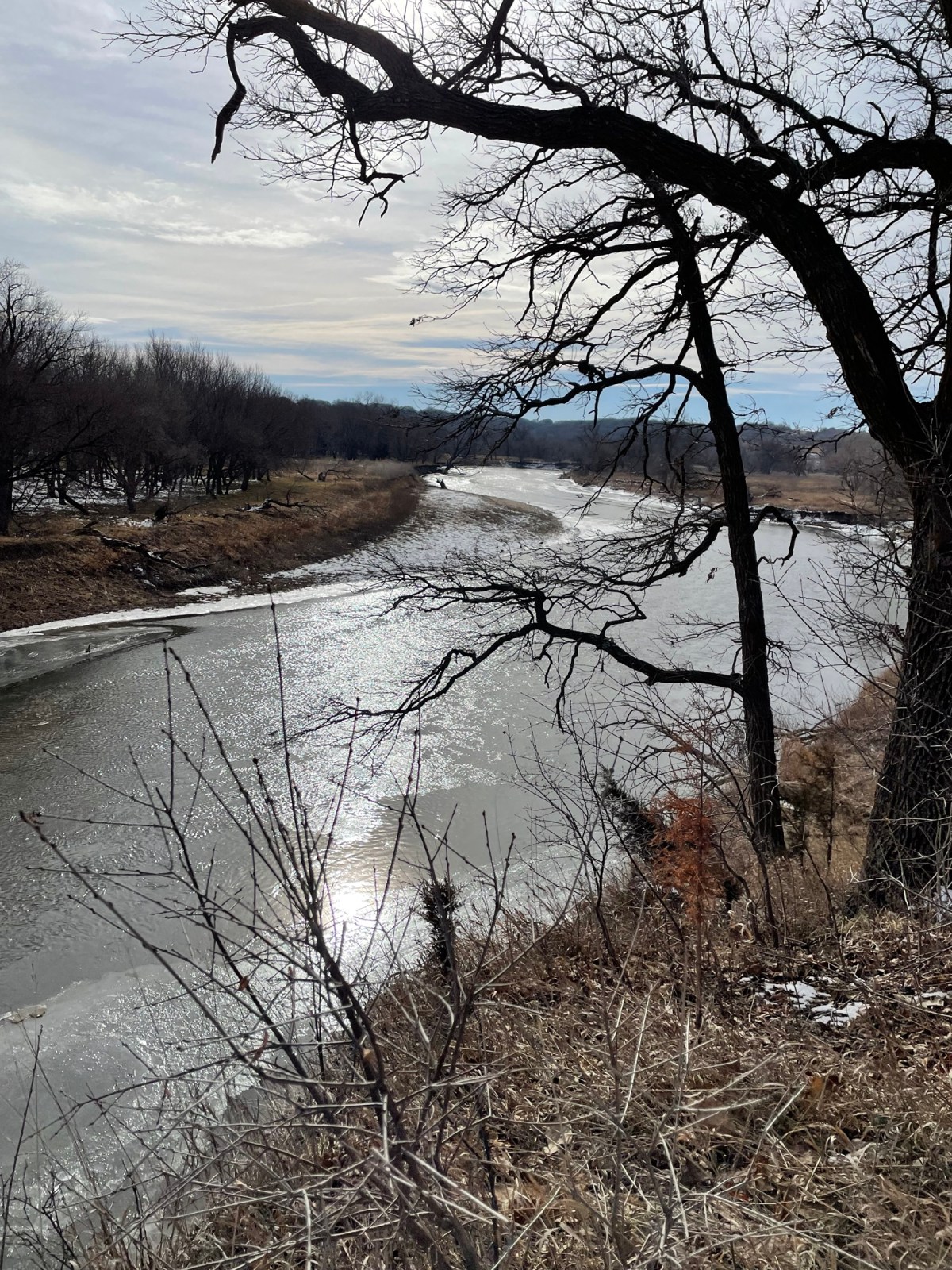
On Sunday, I was eagerly looking forward to Monday and the rest of the week. Since Monday was a holiday and the workplace was closed, I decided to take advantage of the good weather and make plans to go for a morning walk at a local nature area. After that, I planned to spend the afternoon reading and sipping tea. Luckily, the weather held up, the walk was wonderful, and I was able to finish reading my book. The anticipation and hope that I felt on Sunday turned into a reality on Monday.

As Monday slowly came to an end, I couldn’t help but feel an excitement for the upcoming Tuesday. It held the promise of a pivotal business meeting, a flurry of challenging tasks to tackle at work, and to top it all off, a thrilling college basketball game to watch. And boy, did Tuesday deliver! The day flew by, filled with a sense of purpose and accomplishment, just as I had hoped for.

As evening arrived, I was getting ready to watch the best college basketball team in the country, UConn, play against my son’s university team, Creighton. My son is good friends with many of the players, and I have also had the chance to get to know some of them. Watching them play, I often feel like I am watching my own family. However, my hope and anticipation for the game were wavering, and I began to have doubts, similar to what a long-time Minnesota Vikings fan might experience in the fourth quarter of most games. But in the end, the game surpassed my hopes as Creighton emerged victorious. It was two days where hope and reality perfectly aligned.

Recently, we have been eagerly anticipating our upcoming travels. One of the destinations we are most excited about is the Grand Hotel on Mackinac Island. Our first visit there was on our honeymoon, and we have returned several times since then. Even though we have been there before, each visit is unique and just as enjoyable as the first one. We can hardly wait for this trip and are looking forward to having a fantastic time. Only time will tell if our hopes and reality will align.

Upon reflection after a week, Lasso’s argument may have merit. The feeling of hope and anticipation could enhance the overall experience. What are you looking forward to?

I hope you have a great week.

The Battle is Rejoined

It all started with a picture. A picture of me I didn’t like. A picture that motivated a significant lifestyle change. The picture was taken 20 months ago.

Since the picture, I lost a lot of weight. Most of the weight came off in the first three months. Over the last 17 months, there has been a slight downward trend.

All of this is good. I am still 60+ pounds off my high. I have mostly maintained the weight loss (give or take 5 pounds). I am still walking every day (at least 10,000 steps per day for 899 days). Occasionally I jog. I eat healthier than before. I am still amazed by my progress and celebrate the progress I have made so far.

Yet, I want more. I have a new number and fitness level in mind. My new goal is 20 pounds lower (don’t worry – if I lose 20 more pounds, I will still be “overweight” according to CDC BMI guidelines). My new number is a good number. It will put me down 80 or two softener salt bags. My new number will also incorporate some more weight training to obtain a higher fitness level.

So I will blog about it in real-time this time. So I begin with my why:

First, I believe 20 pounds down will be a healthier and happier weight for me. Second, I want to lower my health risks. For further information, search “health risks of being overweight.” Third, I want to break the pattern. Both my fathers died in their mid-60s. (Note: Both ate poorly, smoked, drank, and got little exercise). Fifth, I want to see my children grow older. Finally, I promised my wife a trip in 2044. I need to be around for this.

So the battle is rejoined. 20 pounds or bust – or 20 pounds is a must. Let the fun begin!

Spring and hope

In season one of the hit series Ted Lasso, the main character gives a locker room talk about hope. My take away is hope sustains us and gives us reason to move forward. Hope gives us reason to believe that things are possible.

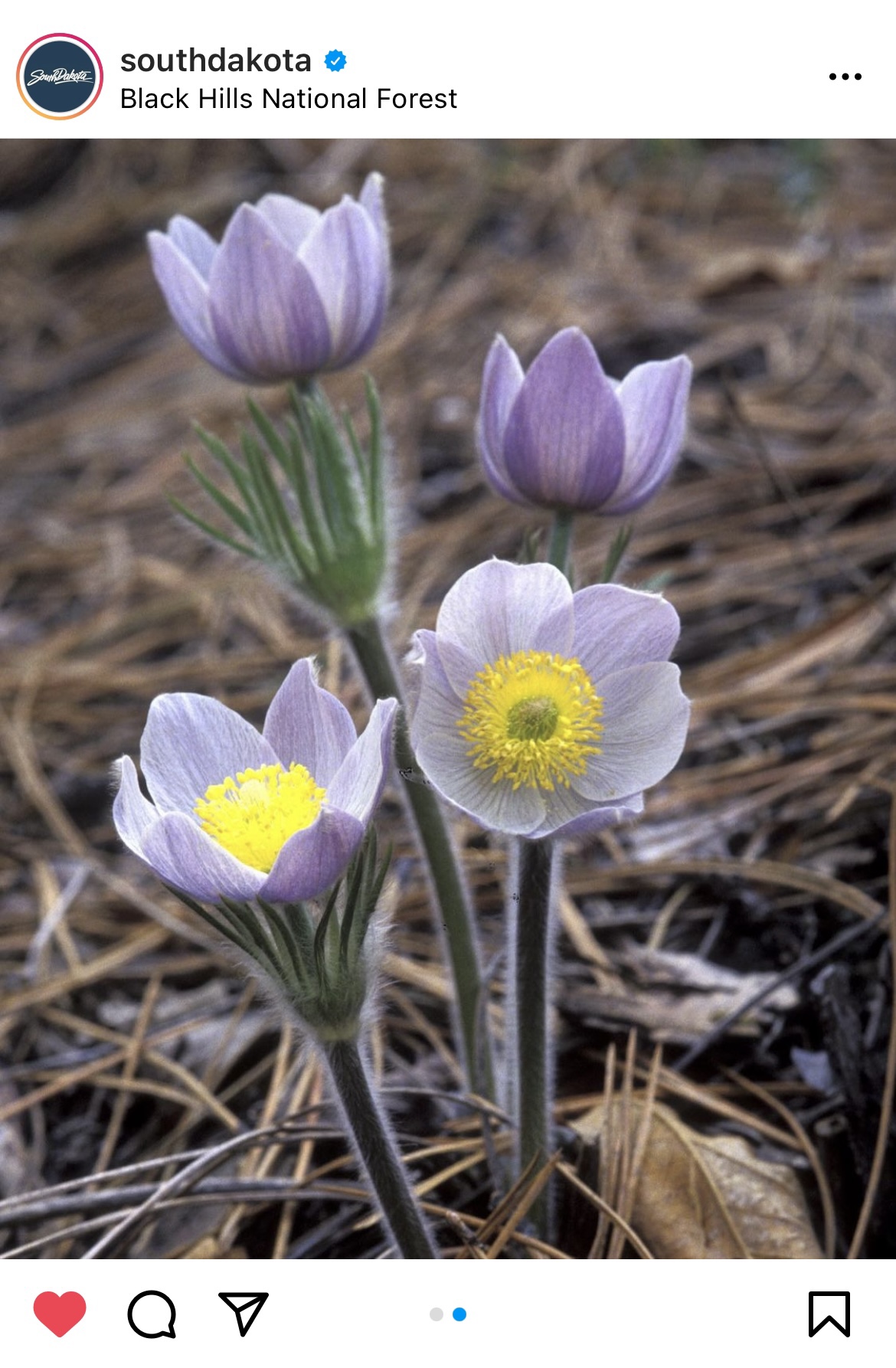
Yesterday, while spending too much time on social media, I found a picture of the “first bloom” of our state flower. The picture is above.

The picture triggered a flood of thoughts and emotions. Instantly, I was transported to my hometown. I was reminded of the joy that spring flowers bring. The beauty of the lavender, yellow and green tones against the brown pine needles are stunning. It has been many years since I have seen this bloom. I would love to see it again.

The picture reminded me of the hope that spring brings. Winter in South Dakota can be harsh. It often teases you by warming up for brief periods in February and March only to get cold and snowing again. There is very little color present. But slowly, The colors begin to emerge. And with the reemergence of color comes hope.

Finally, I was reminded of my mother. When I was a young child I would go outside of our house to pick several of these flowers and make a spring bouquet for my mother. She always acted like it was the best gift she had ever received. The flowers would quickly die and wither. I would pick another bouquet. (I note it is illegal to pick the state flower on public property).

So on this first day of April when many play jokes on each other, take time to be hopeful because spring is here and new opportunities occur.

Day 28 of Gratitude Challenge

First, I would like to say how happy and thankful I am that Michigan beat Ohio State yesterday. I truly don’t measure the value of my life based on a sporting event, but it felt good to cheer them on to victory. Pair it with a Minnesota Vikings win over the Green Packers a week ago – GOOD WEEK.

Yesterday I wrote about my gratitude for pictures. They capture moments and trigger memories. The picture attached to this post is of my father at the helm of his sailboat. What strikes me about this picture is the joy and happiness in his face. Clearly sailing was one of his joys. I wonder what he is thinking about in this picture?

However, this is not the father I remember. My father was a strict perfectionist. He demanded a great deal from us. But he never demanded more from us than he demanded of himself. Growing up with him was very stressful. Unfortunately, some of these traits have passed on to me (I am sorry to my family).

That said, my father gave his all for our family. He loved us deeply and was driven by a need to provide for us. He didn’t always express his love in a positive way. He taught me many lessons and played a major role in shaping me into the person I am today. There is no doubt I am a far better person because of my father. I wish he was still here. I could chose to focus on the negative aspects of my father. Today (and hopefully other days going foward), I choose to focus on the positive impact my father had on my life. I am grateful for my father. The good, the bad and the ugly. Take time to grateful for your father today.

Day 25 of Gratitude Challenge

Today is Thanksgiving. It is a day where we celebrate the blessings of the last year. I plan to spend the day eating with my family, watching football, and cleaning the house for The Gathering. I’m going to take several moments to be grateful for the gifts of the last year.

Here are a few things I am grateful for, over the last year:

  1. Family
  2. 20 years of marriage
  3. Family
  4. Graduation of youngest son
  5. Visiting oldest son several times
  6. Youngest so goes to college
  7. Improved health
  8. Return to the classroom
  9. Return to the office
  10. 1st shot
  11. 2nd Shot
  12. Booster shot
  13. Ginger – The best mini golden doodle

I am grateful for those who read this blog. What are you grateful for? Today, I challenge you to make a gratitude list and post it.

Day 22 of the Gratitude Challenge

Everything is better after the Minnesota Vikings defeat the Green Packers. Also, it is Thanksgiving week. For many in the US, this means at least one day off from work, spending time with family and friends, shopping, and overeating. It also means that one can begin to listen to Christmas tunes.

My Thanksgivings as an adult are not the same as those of my youth. Growing up, our family celebrated Thanksgiving with another family (in later years, we added another family). We rotated which family hosted the meal. After the meal, the kids would play games while the adults debated and solved the problems of the world. I really miss those Thanksgivings. I am so grateful for those Thanksgivings.

In recent years, my family and parents in-law have gathered for a Thanksgiving meal often while watching the Detroit Lions play. We will do the same this year. In addition, my wife’s extended family gets together on the Saturday after Thanksgiving for what is known as The Gathering. The Gathering usually consists of three generations brothers, sisters, aunts, uncles and cousins. Usually there are about 25-30 people in one place telling stories, eating, and laughing. Though it has been a part of my life for over 20 years, it still feels like a new tradition to me.

This year, we are hosting The Gathering. It is a lot of work to prepare for the event. My wife does an amazing job of coordinating all the details. And so our week will be spent preparing and gathering with family.

This year, I am looking forward to this week. Our youngest child be home for a few days. We will get at least two fantastic meals. We will spend time with family and friends. So today, I am grateful for the week to come. I am also grateful that Vikings defeated the Packers What’s something you look forward to in the future?

Weekend Why

Earlier this week, I wrote about the importance of why. A clear and powerful why propels you towards your goal. It is also very important to revisit your why. Often life changes. This weekend, I will spend time reflecting on my why. Is it still applicable? Do I need to modify it? Is it working? Spend time everyday with your why. It will move you towards your goal.