It’s been nearly two months since we moved into our new home, and the question comes from everywhere. Coworkers, neighbors, people I run into. How’s the new house? It reminds me of being a senior in high school, or a freshman in college, when everyone wanted to know the same three things. How’s the college search going? Where are you headed next year? What’s your major? I spent enough years around eighteen-year-olds fielding those same questions that I eventually started handing out advice about it. I used to tell my students the same thing every year. Nobody really cares what your answer is, they just want you to have one. Pick three schools. Pick a major. Tell people a job you’re exploring. Most won’t ask again, and the ones who do just want you to say you’re still exploring it. That’s the trick. Have an answer ready and move on.
I could always give the easy answer. “It’s great,” I’d say, and move on to the next question. That’s easier than explaining any of what’s actually going on. But a new home is different, and the answer is more complicated.
One of my favorite movies is The Shawshank Redemption. I’ve watched it enough times that I’ve lost count, and lately I keep coming back to Brooks. Fifty years in that prison, and by the end he knew every hallway, every routine, every hour of every day without having to think about it. When he finally walked out, the world was too big and too fast, and it broke him. I’d laugh at the comparison if it didn’t feel so true. Twenty-two years in the same house does something to a person. I knew which drawer held the batteries. I knew which stair creaked and which light switch turned on the outside lights. I knew how the sound traveled through the place. I knew where the cat used to hide. And I knew where the measuring cups were. I didn’t think of it as knowledge. It was just how the house and I moved together.
In the new house, I had to look up how to use some of the light switches. Seriously, I have had television remote controls that were less complicated. Turns out a few switches don’t do anything at all, and that’s on purpose, wired for a future we haven’t gotten to yet. I stood in my own hallway flipping a switch that controls nothing, feeling like Brooks staring at a world that had moved on without him. Small mercies exist, though. Garbage day is still the same day it always was, and I felt an embarrassing amount of relief the first week I didn’t have to relearn that too.
Here’s the thing about Brooks. He wasn’t a bad man and he wasn’t weak. He was human. We all get institutionalized by our routines eventually. The routine isn’t the enemy. It’s comfortable, and comfortable isn’t a character flaw. But most of us fight change instinctively, even change we asked for, because the old routine feels like safety, even when it’s stopped serving us.
That’s the part I’m determined to get right that Brooks never had the chance to. He didn’t choose to leave. I did. I chose this house, this neighborhood, this flat and enormous sky, and choosing it means I don’t get to spend the next year mourning the version of me who knew where the batteries were. I get to be the guy who learns where the new drawer is instead.
The rest of the disruption is quieter than a light switch, and harder to fix with a Google search. Twenty-two years builds a rhythm you stop noticing, coffee first, then the walk, then the day starts in whatever order it starts. That rhythm didn’t move with the furniture. Some mornings I catch myself standing in the kitchen waiting for a version of the routine that doesn’t exist here yet.
At the old house, rain meant the basement treadmill, no decision required, just walk down the stairs and keep the streak alive. That treadmill didn’t survive the move, so now rain means an actual choice. Drive to the gym, assuming I can find it, or accept the day off and try not to think about what that does to the streak. I haven’t built a replacement rhythm yet. I’m not sure you can build one on purpose. I think it just accumulates, one repeated morning at a time, until one day you look up and realize you’ve done the same thing enough times that it’s become the thing you do.
For the days when it doesn’t rain, I have found my path here, at least. Same time every morning, same loop, Ginger pulling ahead like she already trusts the route more than I do. There are almost no trees in this new development on the edge of town, and the sky just keeps going. When the sun’s up, I stop and look at it, something the old neighborhood never made me do.
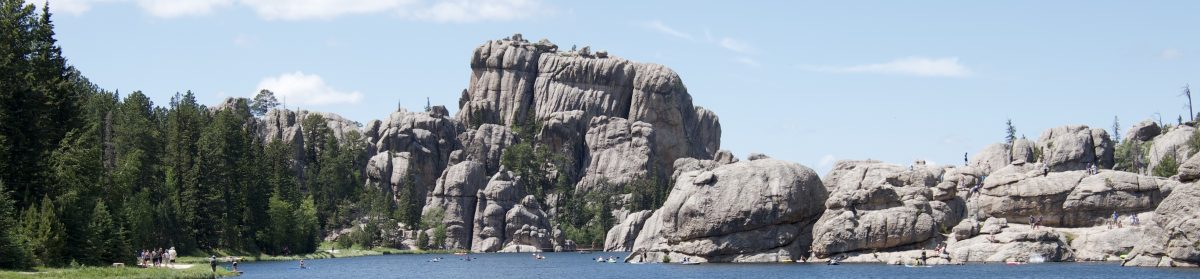
The new neighborhood is flat. It’s flat like a table. There is no topography. Glaciers had their way with this ground thousands of years ago, so I suppose flat was the plan all along. I’ve never been comfortable on the prairie the way I am in the hills. There is nothing better than walking through the forest in the Black Hills, winding your way through the pines. The trees close in around you. You can’t see far, and you don’t need to. Then the trail turns and suddenly you’re standing on an overlook with the whole world opened up below you.
That’s the kind of open I understand. You earn it, and it comes with a place to stand. The prairie gives you the view with nothing around it… no trees to walk through first, no edge to stand on. Some mornings that feels like freedom. Some mornings it feels like exposure. Most mornings it’s both.
The neighborhood itself has its own personality, and it’s not subtle about it. It’s mostly multi family, several blocks of townhomes, rows of villas, a few twin homes, and some single family homes mixed in. It’s like a small HOA convention. Several lawns have signs planted at dog height warning that the grass underneath is not, in fact, a public restroom. I appreciate the honesty, if not the phrasing, though it’s hard to call it neighborly.
But the detail that actually stopped me was the security cameras. I did an informal count on one recent walk and lost track somewhere past a dozen, most of them mounted on townhomes and villas that couldn’t be more than fifteen hundred square feet apiece. Half of them, best I can tell, are angled at the lawns, apparently to make sure no dog commits an undocumented offense. Everyone seems to have a camera pointed at everyone else, but I’m guessing a Flock camera at the entrance would somehow be considered an invasion of privacy.
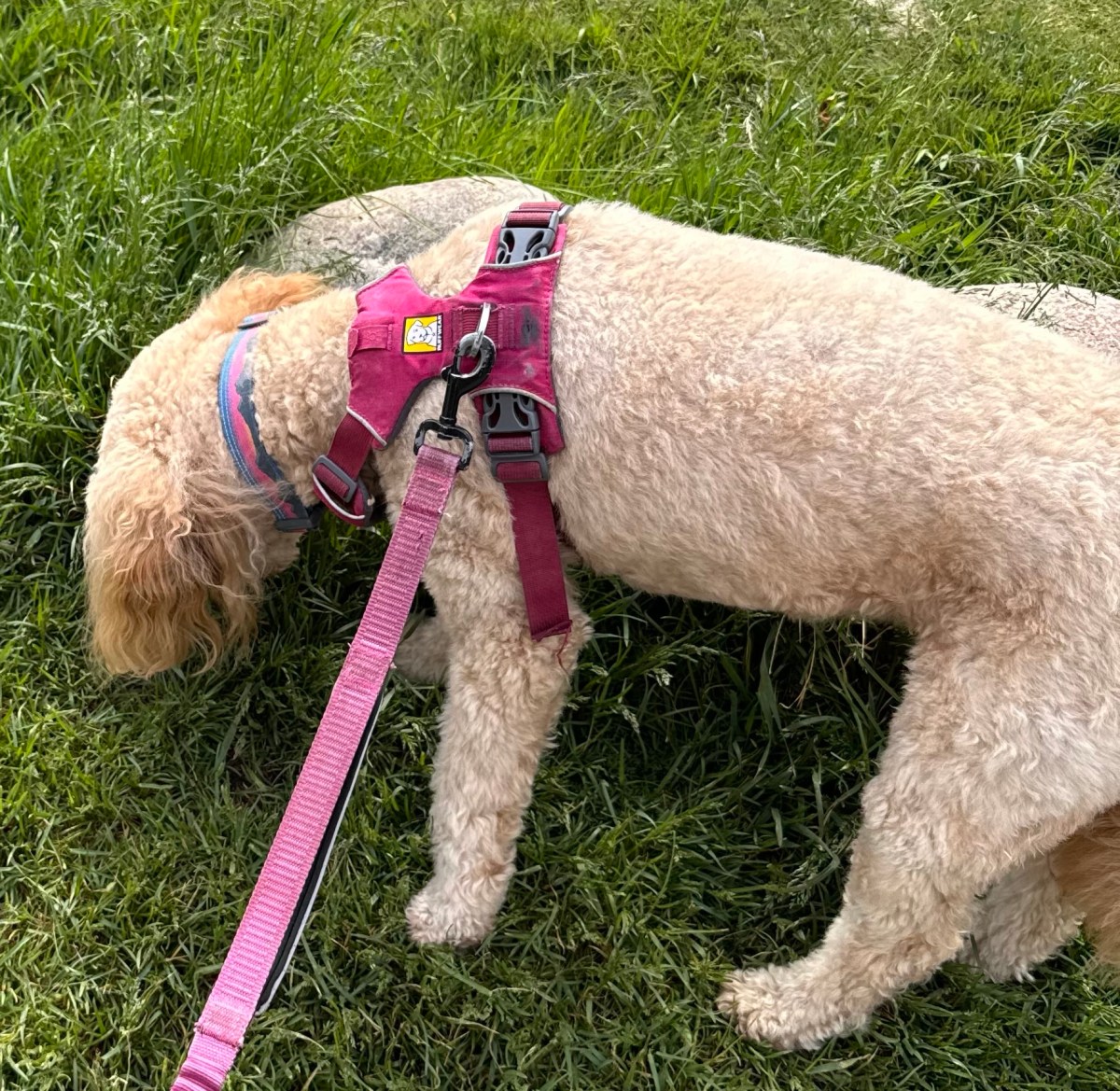
Ginger, for her part, is unbothered by any of the signage, mostly because we never taught her to read. She’s more adaptive than I am. Every walk is still an investigation for her, nose down, working every corner of the block. Fire hydrants and utility boxes get extra time, like they’re holding the important information. The rare tree gets a thorough interrogation, no branch or root left unchecked. She’s also already identified a couple of houses with dogs she’s decided are hostile, and she lets me know it every time we pass, no diplomacy involved.
She hasn’t found her favorite spot yet, the one she used to make a beeline for without thinking, the one that told her she was home before she got there. She’s patient about it in a way I’m trying to learn from. She just keeps sniffing, confident the good spot is out there somewhere. I keep waiting for the same thing to happen to me, some ordinary corner of this new place that quietly becomes mine without me deciding it should.
So if you ask me how the new house is, the honest answer is that it isn’t home yet. Part of that isn’t even philosophical. It’s literal. We ordered furniture back in July, and it still hasn’t arrived, so there are rooms in this house that are technically ours and still feel like they’re waiting for someone else to move in.


